
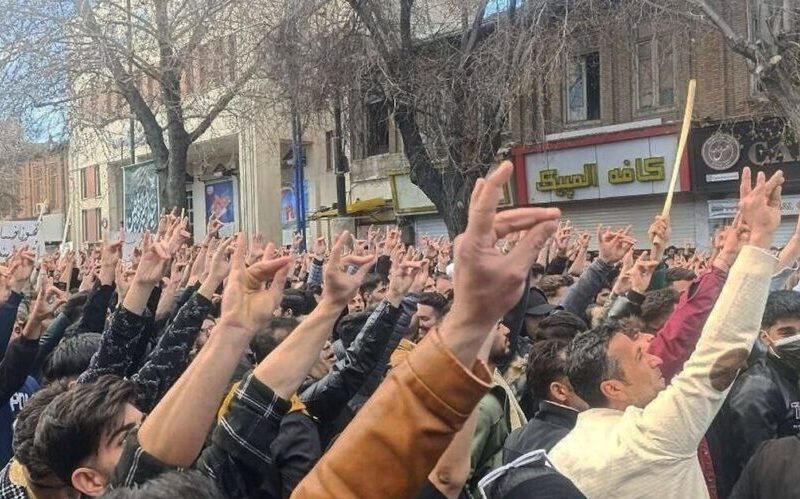
A demonstration in Urmia in West Azerbaijan Province in northwest Iran, March 22, 2025
EA on International Outlets: US-Iran Talks in Islamabad
The US and Israel have been conducting military strikes against Iran targeting nuclear infrastructure, missile production facilities, and Revolutionary Guard installations. Analysts have responded with a focus on institutional survival and regime succession. Most center on which structures can survive sustained military pressure and which external actors will shape the outcome.
Almost all this analysis fails to account for the 47-year investment that the Islamic Republic has made in sustaining inter-ethnic tensions. This has prevented its national and ethnic minorities from organizing against the central government in a unified way.
These tensions are significant for any scenario of transition at the provincial and local level, and of the probability of violence during periods of state weakness.
Ethnic Governance and Why It Matters
Iran is a multi-ethnic state in which no single ethnic group constitutes a demographic majority. Estimates generally place the country’s non-Persian population at roughly 50%. Precision remains limited because the Islamic Republic does not provide regular public, independently-verifiable, disaggregated ethnicity data. Independent research and documentation by NGOs and external researchers faces notable political and security constraints inside the country.
States that govern multiethnic territories routinely collect demographic data to support resource allocation and public service delivery. The sustained absence of such data in Iran’s border provinces serves a specific administrative function. Without a verified demographic baseline, community displacement claims cannot be formally documented. Territorial assertions cannot be verified or refuted. Inter-communal grievances cannot be addressed through institutional channels. The persistence of this ambiguity across 47 years of Islamic Republic governance, and its consistency across different administrations, is inconsistent with an explanation of administrative neglect.
This demographic ambiguity has become relevant as US and Israeli military strikes continue. Reports of the consideration of ground troops and of discussions with Kurdish groups along the Iran-Iraq border increase the probability of civil war. Whether that would strengthen the regime’s position or advance the strategic interests of the U.S. and Israel remains an open question. When institutions that have managed inter-ethnic competition in border provinces lose operational capacity, the tensions which those institutions suppressed are important in what follows.
West Azerbaijan and the Arrival of Displaced Kurds
West Azerbaijan Province is central in those tensions. It borders Iraq, and its population has been shaped by cross-border displacement over several decades. The Kurdish population’s presence arose from Iraqi state policy, specifically the persecution campaigns conducted by Saddam Hussein’s government, and from Tehran’s subsequent decisions about how to manage the resulting refugee flows.
The displacement occurred in two waves. On May 7, 1980, Saddam Hussein signed Decree 666, which authorized the forced deportation and property confiscation of Feyli Kurds, a Shia Kurdish community his government classified as Iranian nationals. An estimated 300,000 to 500,000 Feyli Kurds were deported to Iran, arriving as stateless refugees. The Iraqi Parliament formally recognized the campaign
as genocide in 2011.
A second, larger displacement followed the Iran-Iraq War of the 1980s and the first Gulf War of the early 1990s. Iran provided asylum for an estimated 1.4 million Iraqi refugees, predominantly Kurdish, displaced by the conflicts and subsequent rebellions against Saddam’s government.
The primary settlement areas for Feyli Kurdish and Gulf War refugees were Kermanshah, Ilam, and Lorestan provinces. The aggregate effect of the waves of displacement, combined with the existing Kurdish population in West Azerbaijan’s southern counties, created demographic conditions that the Islamic Republic managed for political purposes.
Administrative Instruments and Their Consequences
The Islamic Republic’s administrative decisions are illustrated by gubernatorial appointments. For the first time in the history of the Islamic Republic, two Shia Kurdish governors from Khorasan and Kermanshah provinces were appointed to administer West Azerbaijan with its mixed population.
Azerbaijanis constitute the majority in the capital Urmia and northern counties. Kurds are a significant presence in the southern and western counties, with the majority adhering to Sunni Islam. So the appointed governors did not represent either the Azerbaijani majority population or the Sunni Kurdish minority of the province.
Provincial naming functioned as another administrative instrument. In 2019, former President Hassan Rouhani, during a visit to East Azerbaijan Province, referred to West Azerbaijan as “Urmia”, the designation preferred by Kurdish nationalist movements. Where “West Azerbaijan” asserts Azerbaijani territorial continuity, “Urmia” implies territorial reorganization favoring Kurdish political platforms. Rouhani’s administration did not correct the usage, and the incident was documented by Azerbaijani community observers as consistent with a broader administrative pattern.
Kurdish community organizations have documented instances in which reconstruction funds for war-damaged villages in West Azerbaijan and Kurdistan provinces were withheld and redirected to housing construction for populations brought in from outside the province. Azerbaijani community organizations have reported analogous patterns in their areas. The directional consistency of this pattern, operating against both communities at
different periods and across multiple administrations, is consistent with a policy of maintaining resource competition in the province.
Territorial Claims
Local Azerbaijani activists have described Tehran’s administrative pattern as a “Kurdification” policy, arguing that it constitutes a systematic effort to dilute Azerbaijani demographic and political influence in Urmia and the surrounding province by elevating Kurdish political visibility.
However, the available evidence does not support the conclusion that Tehran has implemented a state-directed Kurdish settlement program in Azerbaijani territory comparable to the documented Arabization of Iraq’s Kirkuk. Saddam Hussein’s effort involved organized, forced expulsions and structured Arab resettlement with
documentary records.
Territorial claims asserting that Urmia is a Kurdish city, or that West Azerbaijan constitutes “Eastern Kurdistan” in the region of “Rojhelat” are disputed within Kurdish politics and unresolved. The Islamic Republic has allowed and amplified the circulation of these assertions within the province, consistent with its broader interest in maintaining inter-communal competition.
Azerbaijani community organizations and activists describe the perception that their demographic and territorial position in the province is under active pressure. The Coalition of Political Forces of Iranian Kurdistan (CPFIK), established on February 22, has mapped its administrative claims in “Eastern Kurdistan”. They extend into West Azerbaijan, with Azerbaijani communities seeing confirmation of a threat to their presence in the territory.
Conditions and Conflict Risk
US and Israeli strikes have degraded Revolutionary Guards’ operational capacity in western Iran. Reports of armed Kurdish groups entering West Azerbaijan have increased. The Guards have accused the Republic of Azerbaijan of providing intelligence support to Israel and increased surveillance of Azerbaijani Turks inside Iran, adding a layer of state pressure on the population amid competing territorial claims.
Azerbaijani Turkic communities in the province have documented experience with inter-ethnic violence from the last period of significant state weakness. An estimated 100 to 300 people were killed in Sulduz (also known as Naqadeh) in April 1979. Total casualties across West Azerbaijan were around 1,000.
The conditions that produced that violence included a weakening central authority, competing territorial claims over shared geography, and a civilian population without access to institutional recourse. Each of those conditions is currently present in West Azerbaijan.
The reported discussions between US officials and Kurdish groups along the Iran-Iraq border introduce an additional variable. External engagement with one community inside a contested province, in the absence of equivalent engagement with the other, affects the local balance. Azerbaijani Turkic communities in West Azerbaijan Province have no equivalent external interlocutor. That asymmetry does not determine outcomes, but it is a material condition in how communities in the province are calculating their exposure as central institutions lose their enforcement capacity.
The Sulduz mass killing of 1979 is relevant. The documented casualties were not confined to those from direct armed confrontation. A significant portion were secondary conditions that followed the initial breakdown of order, including looting, displacement, and panic in a civilian population that had no functioning institutional protection.
The Risk of Exclusion
Analysis that omits Tehran’s record of ethnic governance record will underestimate the risk of local conflict in Iran’s border provinces and misattribute its sources. Inter-ethnic tension in West Azerbaijan is in significant part a consequence of specific administrative decisions made by a government that maintained instability as an instrument of central control.
The Azerbaijani communities of West Azerbaijan have a documented demographic and historical presence. Kurdish communities have lived in the province for generations, with many members arriving as refugees from documented persecution in Iraq.
These two facts are independently verifiable and do not contradict each other. Analysis that treats those facts as mutually exclusive, or that considers one while omitting the other, will produce an incomplete assessment of the risk of local conflict risk. That increases the probability that civilian populations of West Azerbaijan will bear the consequences of policy decisions made without accurate information about conditions on the ground. It also increases the probability that the Islamic Republic retains operational advantage in this conflict.
