
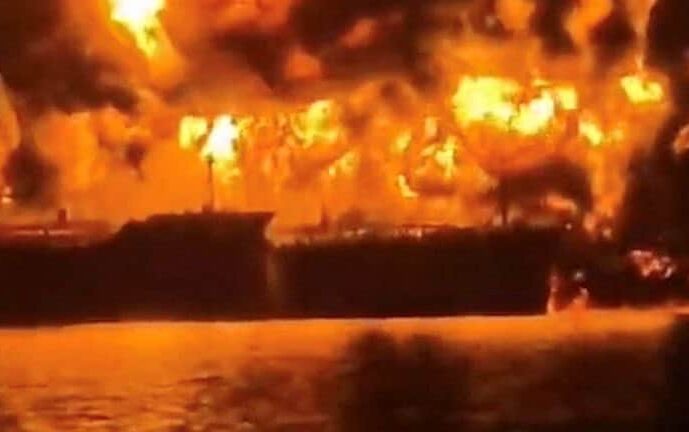
Fuel tankers ablaze after an Iranian attack on the Iraqi port of Basra, March 11, 2026
EA on International Media: US-Israel War on Iran — Trump and Co. Ramble On with No Plan B
US-Israel War on Iran, Day 12: Both Sides Declare “Most Intense” Strikes of War
UPDATE 0710 GMT:
US intelligence services assess that Iran’s leadership is largely intact and is not at risk of collapse soon.
Three officials said a “multitude” of intelligence reports provide “consistent analysis that the regime is not in danger” and “retains control of the Iranian public”.
UPDATE 0635 GMT:
An Israeli strike along the seafront in central Beirut killed at least seven people and wounded 21 early Thursday.
The attack was Israel’s third on the center of the Lebanese capital during the war.
Israeli strikes on Lebanon have killed at least 634 people and injured 1,586 since March 2. More than 816,700 residents have registered as displaced.
Iran’s Lebanese ally Hezbollah launched drones and rockets at northern Israel on Wednesday night, injuring two people.
ORIGINAL ENTRY: Retaliating against the US-Israel War, Iran escalated its strikes on the Gulf States on Wednesday, damaging shipping, energy, and port infrastructure.
In a late-night operation, Iranian boats struck three vessels in the Iraqi port of Basra on the Persian Gulf. Two fuel tankers, the Marshall Islands-flagged Safesea Vishnu and the Malta-flagged Zefyros, were set ablaze.
At least one crew member was killed. Another 38 were rescued, but others are missing.
The attack targeted a ship-to-ship transfer of oil. It is unclear if Iran used a flying or seaborne drone or a missile.
Three merchant ships were hit earlier in the day. The most serious attack was on the Thai-flagged bulk carrier Mayuree Naree, struck around 11 nautical miles north of Oman. Twenty crew members were rescued, but three are trapped in the engine compartment.
A cargo vessel caught fire, forcing its crew to evacuate, while a container ship sustained damage.
Bahrain’s authorities told residents in three areas of Musharraq to stay home after an Iranian attack on fuel tanks. They should “remain in their homes, They should “close windows and ventilation openings as precaution against potential effects of smokes from the fire currently being fought”.
Oman has shifted all vessels out of its main oil export terminal at Mina Al Fahal, outside the Strait of Hormuz, in a precautionary move.
Kuwait said its air defences had downed eight Iranian drones, and Saudi Arabia said it had intercepted five heading toward its Shaybah oil field.
Despite Donald Trump’s proclamations that his Administration would protect shipping in the Strait of Hormuz, the US Navy is still refusing requests from the industry for military escorts. “Sources familiar with the matter” say the risk of attacks is too high for now.
An Iranian official denied a report that it will allow Indian-flagged tankers to pass the Strait without threat of attack.
Oil Price Surges Past $100 Per Barrel
Oil prices recrossed the $100 per barrel threshold on Thursday, surging more than 9%.
The International Energy Agency had tried to stem concerns on Wednesday with its 32 member states approved the release of 400 million barrels from strategic reserves, more than double its largest previous intervention.
The release includes 172 million barrels from US reserves.
But the step was quickly overtaken by the Iranian attacks and the effective closure of the Strait, through which around 25% of maritime oil and 20% of maritime gas passes.
The price of oil, just above $60 per barrel when the US-Israel War was launched on February 28, reached $118 on Monday morning before falling back amid Donald Trump’s assertion that the war was “very complete”. It dropped below $90 before last night’s surge.