
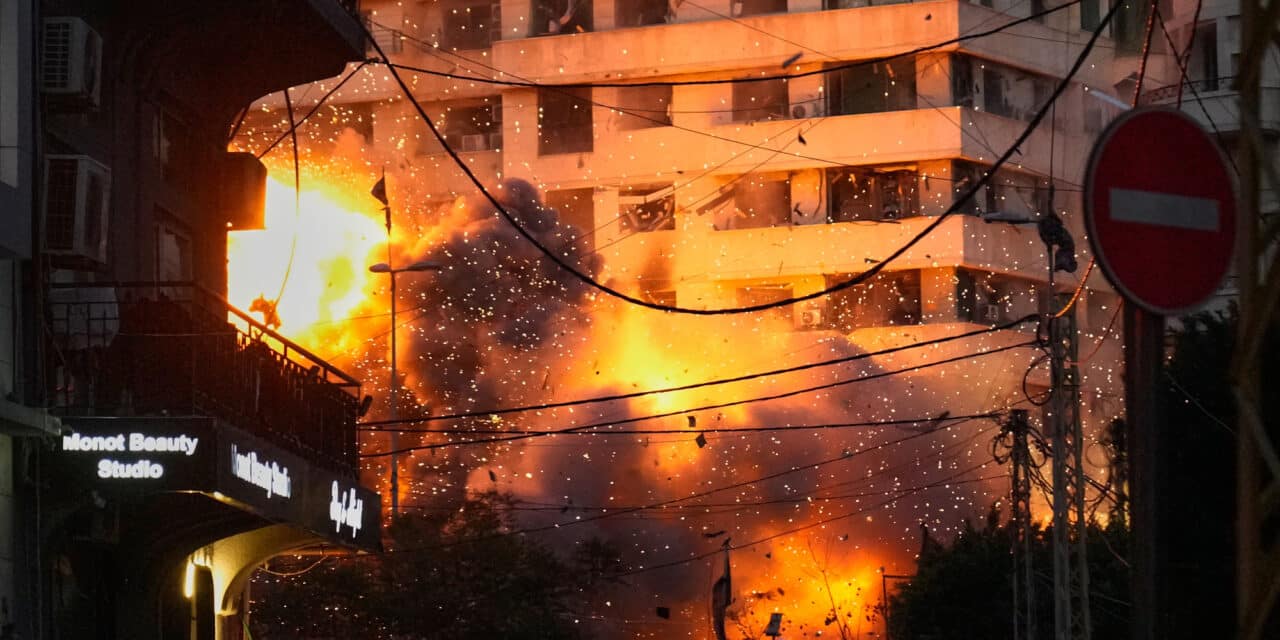
An explosion in a building following an Israeli strike on central Beirut, Lebanon, March 18, 2026
Why the UK is Involved in the US-Israel War on Iran
EA on International Media: US-Israel War on Iran — Trump and Co. Ramble On with No Plan B
The UK has been drawn into the expanding US–Israel war with Iran and its geopolitical consequences. Now, beyond the missiles and retaliatory strikes, is the question: what kind of war is this becoming?
For years, Israel’s military has been guided by the Dahiya Doctrine, named after the neighbourhood in southern Beirut that was heavily bombed in the 2006 Lebanon War.
The Israelis had faced groups such as Hezbollah who do not fight like regular armies. They operate within civilian areas, making traditional deterrence harder. Destroying some weapons or targeting leaders could not stop groups that could quickly rebuild.
So the Dahiya Doctrine does not just try to weaken enemy forces. It seeks overwhelming force against both armed groups and the infrastructure that supports them. Communication networks, power grids, water facilities, and transport routes are targets. The goal is not just to beat fighters in battle. It is to make continued resistance so costly, from both a human and resources perspective, that the area cannot support future attacks or resistance.
In Gaza, much of the urban infrastructure has been destroyed during Israel’s repeated campaigns against Hamas. But if the goal is not just to deter enemies but to weaken them so much that they cannot recover, this starts to look like a “Carthaginian peace”.
The source of the term is Rome’s treatment of Carthage after the Punic Wars. The Romans not only triumphed but destroyed its opponent so completely that it could not return as a rival.
Almost 2,200 years later, the idea of removing threats so they can never return is important in debates about war and security. For Israel, the logic is clear. Traditional deterrence’s effectiveness is temporary, as groups backed by Tehran have rebuilt after every round of fighting. The aim must be to ensure that rebuilding is impossible or too expensive to contemplate.
But strategies based on massive destruction come with serious risks. The Prussian strategist Carl von Clausewitz warned that conflict can spiral into “absolute war” when both sides continue to escalate. This idea is even more dangerous when the main target is a large country rather than a non-state group. Iran, a large nation of almost 90 million people, is not Hezbollah or Hamas.
The Dahiya Doctrine was conceived to impose overwhelming costs on militant organisations embedded in urban environments. But Iran is not a militia network. It is a large and resilient state with strategic depth, a significant population, and decades of experience in prolonged warfare. What may function as deterrence against smaller actors may be far more destabilizing when directed at a country capable of absorbing and responding to sustained pressure.
The debate about strategies like the Dahiya Doctrine is not just about military tactics. It goes to the root of how states achieve security. Is the goal to manage threats through deterrence and containment, or to eliminate them through decisive force?
The distinction matters: wars fought to deter adversaries often remain limited in scope, but those trying to permanently incapacitate rivals tend to expand in scope and ambition. With the idea of a Carthaginian peace, from Gaza to Lebanon and now to Iran, the strategy is rarely to contain conflict. Rather, it is to redraw entire regions.
That is what makes the present moment so dangerous.

First, they thought knocking off Khamenei would make Iran fold. It didn’t. Then they hoped that taking out other leaders would trigger an uprising. Wrong again. Now they’re blabbering about a ground invasion.
Every single murder they commit and all the wreckage they leave behind just glues the Iranian people together and makes the whole world despise them.
The guys running Israel have always been fanatical nutjobs, but this is the first time the U.S. has been led by such an incompetent crew.
Rouhollah Nadiri: Father of Three, Killed by a Shot to the Heart
https://iranwire.com/en/news/150647-rouhollah-nadiri-father-of-three-killed-by-a-shot-to-the-heart/
US and allied radar sites in the Middle East struck at least 10 times: https://abcnews.com/International/us-allied-radar-sites-middle-east-struck-10/story?id=131164670&cid=social_twitter_abcn
“An ABC News analysis of satellite imagery and verified videos suggest that at least 10 radar sites have been struck by Iranian drones or missiles since the start of the war, including apparent damage to radar systems that rely on rare components and cost hundreds of millions of dollars. While the extent of the damage cannot be verified, available imagery suggests that Iranian drones and missiles have been successful in targeting some of the facilities that house the sensitive equipment. “
“He focuses on the need for international accountability… ”
Maybe tell us a little and write an essay on hezbollah’s accountability toward civilian Palestinians. Because this roman history lesson was pretty irrelevant to current affairs. I hope at least you get a good mark for it. I don’t mean to be mean, I just am.
Anonymous,
I appreciate that this excellent analysis did not fit your personal priorities. I am glad that it addresses the priorities and consequences of the US-Iran War on Israel.
S.
“personal priorities”
I get my clues by listening to and reading four five hours a day from general public in iran, people that I don’t know, random people. I am iranian, I speak the language and understand iranians even when I don’t agree with them. That’s where my priorities come from. I don’t follow the lead from my circle of “friends”.