
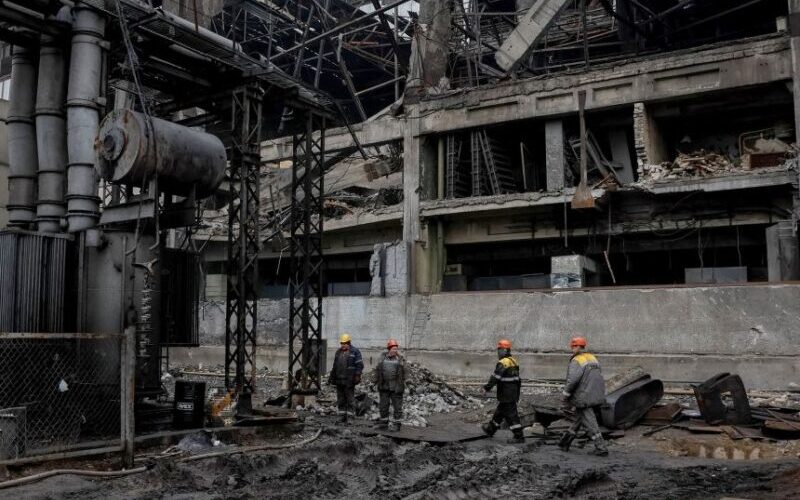
Employees at a thermal power plant damaged by a Russian missile strike on Ukraine, November 13, 2025 (Gleb Garanich/Reuters)
Monday’s Coverage: Zelensky — Document on US Security Guarantees “100% Ready”
UPDATE 1527 GMT:
German Defense Minister Boris Pistorius says Berlin cannot supply Ukraine with more US-made Patriot air defense systems.
Alongside Lithuanian Defense Minister Robertas Kaunas in Berlin, Pistorius said Germany has given “disproportionately” with “more than a third” of its Patriots capacity. The German military is waiting for replacements for the systems transferred to Kyiv.
The Minister acknowledged that Berlin’s provision of its IRIS-systems is not enough given the “massive intensification” of Russian attacks.
“The task for all of us is to jointly check our own reserves, especially those who may still have free capacity,” he said.
UPDATE 1425 GMT:
The Trump Administration is reportedly making US security guarantees to Ukraine contingent on Kyiv giving up the rest of the Donetsk region, in the east of the country, to Russia.
“Eight people familiar with the talks” told the Financial Times of the Administration’s maneuver.
Two of the sources said there must be a full Ukrainian withdrawal from the strategic region.
A senior Ukrainian official said it was increasingly unclear whether the US would commit, “They stop each time the security guarantees can be signed.” The Americans “use the guarantees…to push Ukraine” towards concessions they believe can get “Russia to the table”.
A “person familiar with the US position” insisted that Washington is “not trying to force any territorial concessions upon Ukraine”: “The US has said that security guarantees depend on both sides agreeing to a peace deal, but the contents of the peace deal are up to Russia and Ukraine.”
UPDATE 1423 GMT:
The toll has risen to three civilians killed and 35 injured by Russia’s overnight drone strikes on Odesa (see 0955 GMT).
Russian drone strike in Odesa: Woman’s body found under rubble, death toll rises to 3
Odesa authorities said rescuers recovered a woman’s body from a collapsed residential building after Russia’s overnight drone attack on 27 January. The confirmed death toll is now three. In… pic.twitter.com/2rxIpc4jx1
— Euromaidan Press (@EuromaidanPress) January 27, 2026
UPDATE 1410 GMT:
President Volodymyr Zelensky has posted after a conversation with Austrian Chancellor Christian Stocker:
Ukraine’s accession to the European Union is one of the key security guarantees not only for us, but also for all of Europe. After all, Europe’s collective strength is possible, in particular, thanks to Ukraine’s security, technological, and economic contributions. That is why we are speaking about a concrete date – 2027 – and we count on partners’ support for our position.
UPDATE 1402 GMT:
Ukraine President Volodymyr Zelensky has coordinated with officials about the energy situation after the latest Russian attacks, including strikes on Odesa (see 0955 GMT).
“It is important that the entire country is now united to stabilize the situation and ensure the resilience of our state,” he posted.
I held a coordination call on the situation in the regions and communities. The Ministry of Defense of Ukraine, the Air Force Command, and regional authorities are analyzing the circumstances of the strike on Odesa – there were 52 Russian drones in total, and a significant number… pic.twitter.com/hINosMPcfb
— Volodymyr Zelenskyy / Володимир Зеленський (@ZelenskyyUa) January 27, 2026
UPDATE 1131 GMT:
Slovakia has joined Hungary in a legal challenge to the European Union’s ban on Russian gas imports.
On Monday the EU, supported by almost all of the 27 member countries, approved the ban on Russian liquified natural gas by January 1, 2027, and on pipeline gas by September 30, 2027.
The two countries will pursue separate claims, said Slovakian Prime Minister Robert Fico, but will “coordinate” their arguments.
European Commission spokesperson Paula Pinho responded, “We really stand by the legislation, and there is solid legal work behind [it], so we are also very confident that we are in a position to defend the legislation that has been widely endorsed by the member states.”
UPDATE 0955 GMT:
At least one civilian has been murdered and at least 27 injured by a massive Russian drone attack on Odesa in southern Ukraine.
The 50-drone assault, which began just after 2 a.m., struck several apartment and university buildings, a preschool, and a church. More victims are under rubble.
“The destruction is colossal, and repair work will require extended time to return equipment to working condition,” energy provider DTEK wrote.
Russian forces hit the same Odesa energy facility twice, causing "colossal" destruction that requires extended repairs, DTEK Odesa Electric Networks reports. Two city districts are without power
The video shows the aftermath of the Russian attack on a residential building in the… pic.twitter.com/aqMRbxAifw
— Euromaidan Press (@EuromaidanPress) January 27, 2026
Ukraine President Volodymyr Zelensky commented:
Every such Russian strike erodes the diplomacy that is still ongoing and undermines the efforts of partners who are helping to end this war. We expect the United States, Europe, and other partners not to remain silent about this and to remember that achieving real peace requires pressure precisely on Moscow – sanctions, the blocking of Russian operations and the entire infrastructure of Russia’s tanker fleet. Without pressure on the aggressor, wars do not stop – just as they do not stop without support for those who defend life.
A brutal drone attack on Odesa. The Russians launched more than 50 drones at the city, with energy infrastructure and civilian facilities as the primary target. Five residential buildings were damaged as a result of this strike, with significant destruction to apartments and… pic.twitter.com/lorBXNRg0x
— Volodymyr Zelenskyy / Володимир Зеленський (@ZelenskyyUa) January 27, 2026
ORIGINAL ENTRY: Ukraine, with the support of partners, is battling to restore its energy sector amid Russia’s mass missile and drone strikes.
Since January 9, Russia has launched three of its largest waves of attacks, knocking out the power grid in up to 80% of the country at times.
On Monday, the Russians targeted Ukraine’s second city Kharkiv and the surrounding region. Around 80% of residents the city lost power, amid night-time temperatures as low as -14C (7F) and two people were injured.
NATO Secretary General Mark Rutte warned the European Parliament that Ukraine is facing its “harshest winter” for more than a decade.
Hours later, in his nightly address to the nation, Ukraine President Volodymyr Zelensky spoke of the multiple areas “where the situation is most difficult”, particularly the capital Kyiv:
Restoration of the energy sector after Russian strikes is ongoing round-the-clock. I thank all our friends—European countries from Norway to Italy, Poland and Germany, the Baltic states, and many others who are supporting Ukraine and our cities—and doing a lot for Kyiv right now. pic.twitter.com/yFkqssI0iZ
— Volodymyr Zelenskyy / Володимир Зеленський (@ZelenskyyUa) January 26, 2026
On Saturday, the European Commission announced the despatch of 447 emergency generators. The next day, Lithuanian President Gitanas Nauseda pledged 100 generators during Zelensky’s visit to Vilnius.
A grassroots fundraising effort in Czechia has raised more than €5.4 million ($6.4 million) to buy generators, heaters, and batteries.

Trackbacks/Pingbacks