
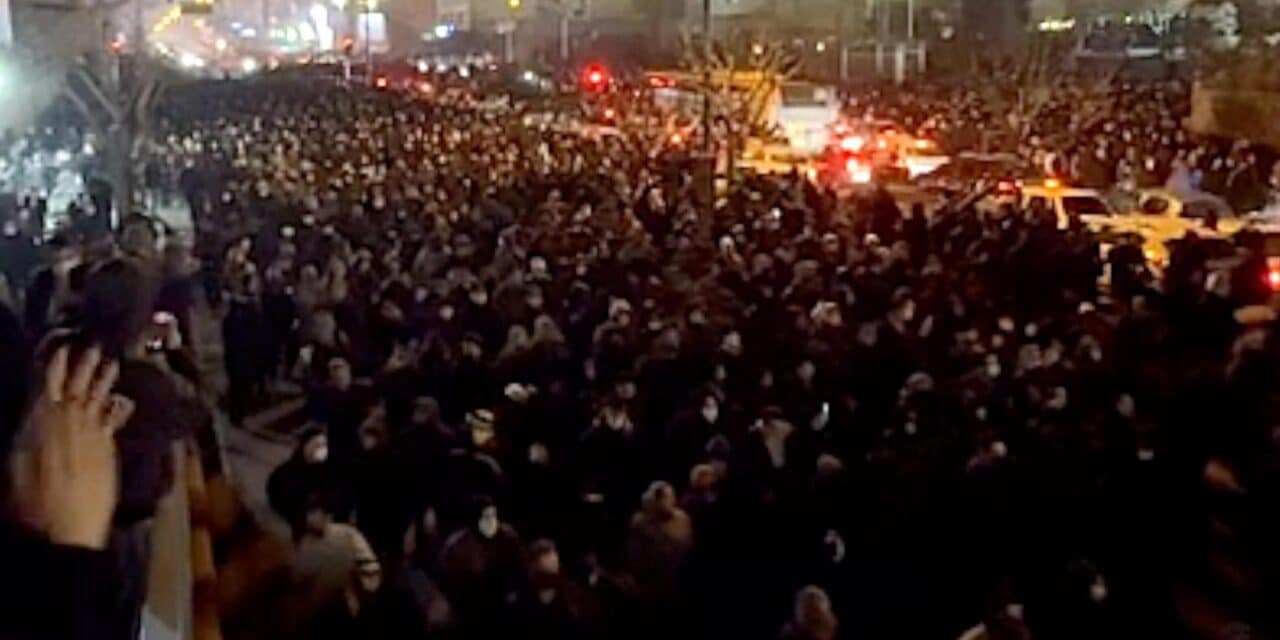
Protest in Tehran, Iran, January 8, 2026
Co-published with The Conversation:
EA on International Outlets: The State of Iran’s Protests
EA-Byline Times Podcast: How Far Can Iran’s Protests Go?
Iran Protests: Trump Backs Out of Military Action
A US intervention in Iran appeared imminent this week. US and UK troops were pulled out of several bases around the Middle East, US military assets had been moved into position and the US president, Donald Trump, had reassured protesters on the streets of Iran that “help is on its way”.
But then the US president told reporters on the afternoon of January 14 that he had received information from “very good sources” that “the killing has stopped” and that planned executions of protesters would not now proceed.
So where does this leave the protest movement in Iran? In two and a half weeks of protests across the country, more than 3,400 people are confirmed to have been killed and more than 18,000 people arrested. The theocratic regime which has ruled the country since the 1979 revolution has been shaken to its core, but – like on several occasions in the past 25 years – appears to have survived yet another nationwide wave of protest and dissent from a population that overwhelmingly rejects its oppressive governance.
We speak to Scott Lucas, an expert in Middle East politics at University College Dublin, who addresses several key issues.
Do you think a US intervention in Iran is now off the cards?
I hate to make this a story about Donald Trump. It should focus on the important people – the Iranians who are risking their lives to pursue rights and reforms – but here goes.
The logical approach for any US administration considering intervening in a situation like this is to consider both the situation inside Iran as well as the regional dynamics. But the US president does not act logically. He’s a mess of contradictions, wanting to be a bully and a “President of Peace” at the same time.
So he blusters for days that he will unleash the US military on Iran’s regime. But he’s also seduced by signals from Tehran that it is willing to enter negotiations with him.
On Wednesday, Trump officials let European and Israeli counterparts know that US strikes are imminent. But Iran’s leaders send another signal: we have stopped killing protesters and we will not execute them. So Trump goes back into his “maybe they will speak to me as the president of peace” mode. So the strikes have been suspended.
Avoiding what could have been a disastrous confrontation between the US and Iran is a relief for the region – and the wider world. But the Iranians risking their lives on the streets will feel abandoned and discouraged.
There have been several waves of protest this century. Are things any different this time?
I think of these nationwide protests, going back more than 25 years, as waves hitting the Iranian shore. There was a first wave in 1999, which began in the universities, for political and social freedoms. Ten years later, there was a far larger wave – the largest since the 1979 Islamic Revolution – after the regime manipulated the 2009 presidential election.
In 2019, the protests were over economic conditions, particularly the prices of petrol, food and essential goods. It was only three years until the next wave, the 2022 marches which lasted for months for “Woman, Life, Freedom”.
On each occasion, through the combination of deadly force, detentions, cut-off communication and decapitation of the opposition’s leadership, the regime has quelled the public displays. But both the discontent and the desire for freedoms are below the surface, waiting to propel another wave.
That came in December 2025 with the catalyst of the collapsing currency, which fed an inflation threatening both households and vendors. However, the wider aspirations of many Iranians soon expanded this into a renewed challenge to the regime’s legitimacy.
Ali Khamenei is already reportedly planning his retirement. How does the Islamic Republic adapt if it wants to survive?
Personally, I don’t think the Supreme Leader will quit until he is too ill to carry on. So while less prominent on a daily basis, he is still head of the regime for the foreseeable future.
The other question is even easier to answer because the regime has given its response. It does not adapt: it refers to the same political playbook which it has used since the first big wave of student protests in 1999. Intimidate the opposition and the protesters. Detain them. Abuse them. Force them to “confess”. Kill them if necessary. Restrict communications.
And then call out your supporters to the streets. Use state media and your spokespeople – one of them, the main unofficial English-language talking head, is a former colleague from the University of Birmingham, Seyed Mohammad Marandi – to insist that genuine Iranians back the regime and that the protesters are puppets of the US and Israel.
Israel and the Arab states advised Trump against a US intervention. Why?
While Israel, Saudi Arabia, the UAE and the other Gulf States benefit from a weakened Iranian regime, they do not want one which collapses without an obvious successor.
Paradoxically, they also know that US military intervention could strengthen the Iranian leadership. Since 1999, the regime has relied on portrayal of its opponents as American and Israeli agents. An American attack strengthens that narrative.
But the fundamental calculation is likely that a US assault will result in instability throughout the region. Iran might retaliate against American positions or those of the Gulf States. It could threaten the Strait of Hormuz, through which about 20% of seaborne LNG (liquefied natural gas) and 25% of oil passes. While its allies in the Middle East have been weakened, from Hezbollah to the Houthis, there still could be consequences in Lebanon, Yemen, and other countries.
Could Reza Pahlavi unify the country or provide an interim solution?
I’m sceptical about parachuting the late Shah’s son into Iran as its “leader”, whether on the throne or another seat of power. He left the country at age 18 in 1979. Since then, having declared himself Shah and leader of a government-in-exile, he has forged ties with monarchist groups, but has been rejected by others in the opposition.
Some Iranian diaspora groups and their overseas supporters are fervent proponents of Pahlavi, and some inside Iran no doubt would favour him as an option. But from talking to my personal contacts, and all the evidence you see reported in the media, and in surveys such as the one published in The Conversation on January 12, most Iranians are not looking for a return to the monarchy.
People also know from the experience of neighboring Iraq in 2003, that imposing a leader from outside may not work out well. The US-supervised administration under Ahmad Chalabi, who – like Pahlavi – had spent more than 40 years outside the country, soon collapsed. Iraq went through an insurgency and civil war in which hundreds of thousands were killed.
That raises a wider, more important issue in which Pahlavi should be set aside. For all the scale and potential of the protests, the opposition does not have the organisation for its political, social and economic ambitions. The regime has seen to that with its decapitation strategy, imprisoning prominent activists from all spheres of Iranian society. How can protesters and the opposition be supported in developing that organisation?
The regime has imprisoned a number of popular democracy figures – could any of them be a credible leader?
I don’t think of this in terms of a “leader” but in terms of the organisation to which I just referred.
Long-time political prisoners include politicians such as Mostafa Tajzadeh, the former Interior Minister who has been behind bars for most of the past 16 years. Then there are human rights activists such as Nobel Peace laureate Narges Mohammadi and Majid Tavakoli. There are also lawyers such as Nasrin Sotoudeh, as well as unionists, students and journalists.
Mir Hossein Mousavi was Prime Minister between 1981 and 1989 (when the regime abolished the role) and the man who reportedly led the first round of the 2009 Presidential election, before the regime’s intervention. Mousavi has been under strict house arrest with his wife the artist, academic and activist Zahra Rahnavard, since February 2011.
Mousavi’s release would be important symbolically. Freedom for others would be a practical boost to the opposition: they could provide the makings of an organised movement which could engage the regime for the changes needed for political, economic and social space.
That is why, rather than headlining Donald Trump’s bluster about military action, I wish people would focus on releasing these prisoners as well as opening up communications within Iran, and between Iran and the outside world.

Iran protests instigated by Israel to distract from Gaza ‘genocide,’ Columbia professor claims: https://www.foxnews.com/us/iran-protests-instigated-by-israel-distract-from-gaza-genocide-columbia-professor-claims
“What you are seeing today is Israel instigated revolt, because there are Mossad agents in the streets of Tehran hiding among Iranian demonstrators,” said Columbia University professor Hamid Dabashi in an interview with Al Jazeera.”
Hamid Dabashi was a firm supporter of the Green Movement in 2009-2010.
“It does not adapt: it refers to the same political playbook which it has used since the first big wave of student protests in 1999. Intimidate the opposition and the protesters. Detain them. Abuse them. Force them to “confess”. Kill them if necessary. Restrict communications. And then call out your supporters to the streets. Use state media and your spokespeople – one of them, the main unofficial English-language talking head, is a former colleague from the University of Birmingham, Seyed Mohammad Marandi – to insist that genuine Iranians back the regime and that the protesters are puppets of the US and Israel.”
But it works!
https://www.jpost.com/middle-east/iran-news/article-883524
“Go out together into the streets. The time has come,” the Mossad wrote. “We are with you,” it added. “Not only from a distance and verbally. We are with you in the field.”
“”
“What is HRANA, the US-based group behind Iran’s death toll figures?” https://www.aljazeera.com/news/2026/1/15/what-is-hrana-the-us-based-group-behind-irans-death-toll-figures
“Al Jazeera contacted HRANA for comment, but a spokesperson declined to disclose information about the group’s members or funding sources, citing security concerns. ….The spokesperson told Al Jazeera that the organisation confirms all data with primary sources, but said it could not disclose the identities of individuals or organisations in Iran with whom HRANA corroborates information. Its methodology for collecting and analysing data is not provided on its website.”
HRANA has stated it increased the death toll massively based on videos of mortuaries and equipment.
Based on the survey you provide here which does corroborate an earlier survey done by “gamaan institute”, RP can have anywhere between 50-80% support given the circumstance,. That is by far more support than any numbers I have seen for either parties in the US at election time for decades.Does that make current or the last US governments illegitimate too?
“Some Iranian diaspora groups and their overseas supporters are fervent proponents of Pahlavi,…”
That may be in part true, but did it occur to you that just like in the US, there are people in between, they are not staunch for one side or the other?
Sitting in high place doesn’t provide the best perspective– often moderate people in political scene don’t shout, as such, you don’t see them jumping up and down to get your attention.
There is one thing iranians have learned (hopefully) from 1979 events, being silent majority have cost them dearly. Today, you can’t expect that older silent majority inside iran to pour into streets for obvious reasons. But you see that outside iran (you often condescendingly call diaspora). Outside, they pour out in large numbers not because they all are so ra ra for RP, it is because once they kept quiet and they lost so much.Now, they are hoping they can reverse the damage. They see RP still standing, they trust he means well for his country. Does he have the wisdom and experience? No, he is learning on the job.
Which one of people you enlist above have the wisdom and competence? How come they didn’t succeed? Why are they in prison? The short answer? Each had their own blunders, each stood on the wrong side of what should have been when they had a chance, each believed in what was not true. And some of them are paying for that shortcoming. Not all people calling for RP are monarchists, even RP is not if left on his own. Just like in the US– not everyone who voted for DT is his supporter.
In 2009, a blind could have seen none of that election circus would go anywhere, it was sham election, tv debates, campaigns, just to pretend we have elections in iran. In a system that from the beginning, literally decedents disappear, people are taken and no one hears of them again you thought you were going to vote for someone that SL didn’t approve? You really thought so? What evidence this very wise (leader) Mousavi had seen in 2009 that showed he could “vote” against wishes of SL.