
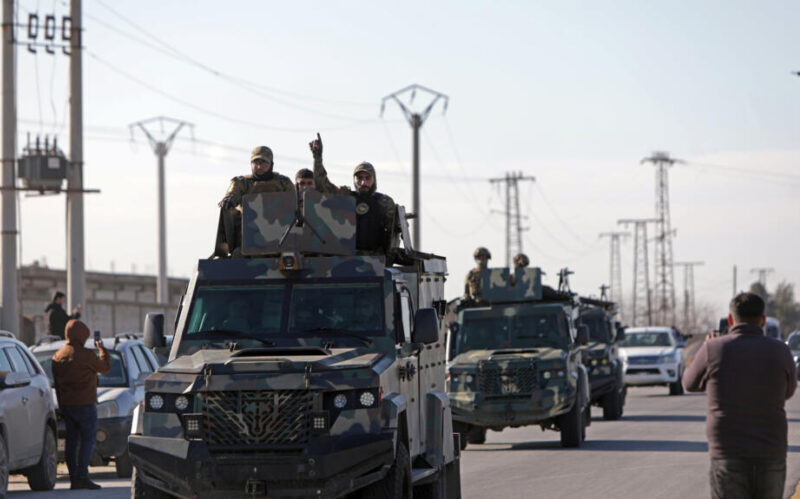
Syrian Government forces in Aleppo Province (Bakr Alkasem/AFP)
UPDATE 1652 GMT:
Syrian President Ahmed al Sharaa and the head of the Kurdish-led Syrian Democratic Forces, Mazloum Abdi, have signed a military and political deal in Damascus.
The agreement establishes an immediate ceasefire, with all SDF units withdrawing east of the Euphrates River “as a preliminary step for redeployment”.
SDF personnel will be integrated into the Defense and Interior Ministries on an “individual” basis.
The administration and military offices of the Deir ez-Zor and Raqqa Governorates in north and northeast Syria will be handed over to the Syrian Government. The civilian institutions in the Hasakah Governorate will be integrated into the Syrian State.
Damascus will take control of all oil and gas fields and border crossing while considering the “special case of Kurdish areas”.
The SDF commits to removing all members of the Turkish Kurdish organization PKK “to ensure sovereignty and regional stability”, while the Government commits to the return of Kurdish residents of areas of Aleppo city to their homes.
NEW — Here's the comprehensive integration deal now in place in #Syria — in Arabic & English.#SDF fighters are to be integrated as individuals, not entire Divisions; a major change since the deal agreed in-person in October 2025. pic.twitter.com/mZXQH6BwBq
— Charles Lister (@Charles_Lister) January 18, 2026
ORIGINAL ENTRY: Forces of the Syria government have taken control of Kurdish areas in the north of the country, after months of talks failed to resolve issues between the two sides.
Having pushed the US-backed, Kurdish-led Syrian Democratic Forces out of Aleppo Province, Government troops moved further east. They took over the city of Taqba, its dam, and the Freedom Dam, west of the city of Raqaa.
At the same time, Syrian President Ahmed al-Sharaa tried to win over Kurdish communities with a decree declaring Kurdish a national language and granting Kurdish groups official recognition.
In March, three months after the fall of the Assad regime, a deal was announced between the government and Kurdish authorities. Kurdish areas, mainly in Syria’s northeast, would be part of a federal system and the SDF would be integrated into the state.
However, negotiations stalled over implementation.
Last week Government troops forced the SDF out of two neighborhoods in Aleppo, Syria’s largest city, and took control of an area to the east. They gathered around villages just west of the winding Euphrates River and called on the SDF to redeploy on the opposite bank.
The SDF pulled back early Saturday, but said the Government “violated the recent agreements and betrayed our forces” by pushing farther to the east, with clashes south of Tabqa. The army urged the SDF to “immediately fulfil its announced commitments and fully withdraw”.
Syrian State media said the SDF destroyed two main bridges over the Euphrates in the Raqqa region, one in Raqqa city and another leading to it.
US Response
The US military, which has supported the SDF since its creation in October 2015 to fight the Islamic State, called on the Government to halt its advance. Gen. Brad Cooper, the head of Central Command, said troops should “cease any offensive actions in areas” between Aleppo city and Tabqa, around 160 km (100 miles) to the east.
US-led coalition planes flew over the flashpoint towns, releasing warning flares.
US envoy Tom Barrack travelled to Erbil in northern Iraq on Saturday to meet with SDF commander Mazloum Abdi and Iraqi Kurdish leader Masoud Barzani.
The Government Advance
In the town of Deir Hafer and surrounding villages, whose residents are predominantly Arab, the transition to Government control was relatively smooth. Some celebrated the change such as Hussein al-Khalaf:
It happened with the least amount of losses. There’s been enough blood in this country, Syria. We have sacrificed and lost enough – people are tired of it.
The Syrian Petroleum Company said troops were in the nearby oilfields of Rasafa and Sufyan, and they could be brought back online.
The SDF had said they would defend Taqba, its nearby dam, and another oilfield in its vicinity.