
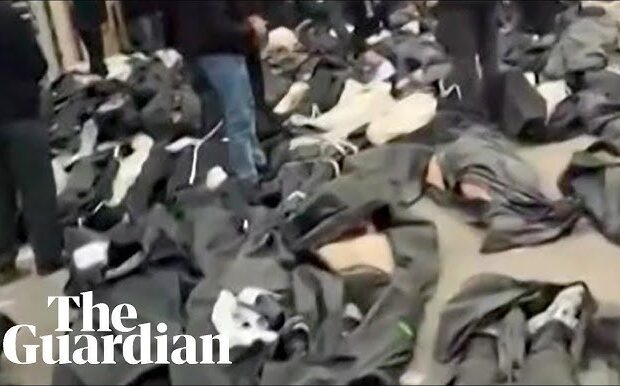
Bodies outside the Kahrizak morgue in Tehran, January 2026
EA on WION: After Deadly Repression of Protests, Iran’s Regime is Nervous
UPDATES: Iran’s Regime Brutally Suppresses Protests…For Now
On Friday, January 9, Iran’s Supreme Leader Ali Khamenei was facing one of the greatest challenges to his 36-year rule.
Twelve days earlier, shopkeepers and merchants had come out on strike in markets and bazaars across the country, including in the capital Tehran. The catalyst was the collapsing Iranian currency, which had fed inflation and undermined business.
The demonstrations soon expanded to include the long-standing desire of Iranians for rights, justice, and political and social space.
The regime had cut down mass protests after the disputed 2009 Presidential election; in 2017 and 2019 over economic conditions; and in 2022 over “Woman, Life, Freedom” after the death in police custody of Mahsa Amini. It had decapitated the opposition through violence, repression, and detentions: the leader of the Green Movement and possible winner of the 2009 election, Mir Hossein Mousavi, has been under strict house arrest since February 2011.
Now the challenge had been renewed. It was magnified on January 8 when the son of the late Shah, Reza Pahlavi, made a high-profile call for Iranians to turn out in all cities and towns.
The following day, the Supreme Leader issued his order to the Supreme National Security Council: crush the protests by any means necessary. “Two Iranian officials briefed” on the directive said security forces were deployed to shoot to kill and to show no mercy.
Ayatollah Khamenei’s confirmed the deadly use of force that escalated on the night of January 8. Throughout the following day and over the weekend, the Iranian military, paramilitary Basij, and security personnel unleashed their full assault.
The extent of the killings is still not established. Human rights activists have confirmed the slaying of more than 5,200 people, including 36 children. Unconfirmed claims put the figure as high as 36,500.
The New York Times confirmed more than 40 videos of security forces opening fire on protesters in at least 19 cities and in at least six different neighborhoods in Tehran. In one case, security personnel shot at protesters from the rooftop of a police station in Tehran Pars for more than six minutes.
Times journalists interviewed dozens of witnesses and family members in Iran, reviewed more than 160 videos and photos, and spoke with Iranian officials, rights groups, and medical workers.
Eight doctors and a nurse spoke of hospitals swamped by thousands of injured protesters in Tehran, Mashhad, Isfahan and Zanjan. As medical staff frantically tried to save lives amid shortages of blodd, patients lay on benches, chairs, and bare floors. Medics desperately sought trauma and vascular surgeons,, but the regime’s shutdown of the Internet prevented staff from checking patients’ names and medical histories.
A Tehran surgeon wrote in The Guardian:
Very quickly, the hospital became a mass casualty zone. We did not have enough of anything: not enough surgeons, not enough nurses, not enough anaesthesiologists, not enough operating rooms, not enough blood products. Not enough time. Patients kept arriving faster than we could treat them. Stretchers lined up. Operating rooms turned over again and again.
In a hospital that would normally perform two emergency surgeries in a night, we carried out about 18 operations between 9pm and 6am. When morning came, some patients from that night were still on the operating table.
There was no pause. No moment to step back and assess. You moved from one patient to the next, from one operating room to another. I have worked through earthquakes and seen mass casualties after major accidents. I have never experienced anything like this.
In Tehran’s main morgue, the Kahrizak Forensic Center, several hundred bodies in black plastic bags were stacked in refrigerators, placed on the floor, and scattered in rows on the ground in the parking lot and courtyard.
By January 12, the mass killings across Iran had scattered the demonstrations.
Lawyer Raha Bahreini summarized, “This is not merely a violent protest crackdown. It is a state-orchestrated massacre.”

[Editor’s Note: The official line from the Iranian regime….]
Authorities reveal the weapons used by the “protesters” against the security forces and civilians during the unrest:
https://www.mehrnews.com/news/6737911
https://www.hamshahrionline.ir/news/1011325
https://www.alef.ir/news/4041105052.html
Types of Rioter Weapons|: Investigations and reports of police and security agencies’ arrests of elements involved in the recent unrest indicate the use of a wide range of firearms by rioters and terrorist including the following:
Firearms
Colt Camry
Israeli Yuzi
Kalashnikov rifle
shotgun
Hunting rifle
Cold Arms
knife
Peak
Types of Swords
Axe
Claw Box
Types of fire sprinklers
Molotov cocktails
Combat and improvised explosive grenades
Nasrin Sotoudeh: The World Must Uphold International Law in Iran
https://iranwire.com/en/features/148406-nasrin-sotoudeh-the-world-must-uphold-international-law-in-iran/
She is one of the most respected persons among iranians regardless of politics.
Here is an account of a meeting that had taken place on Jan 5-6th. It was attended by khamenei and the rest of high ranking security apparatus where khamenei issues directives for how the protesters should be dealt with. This is according to what two informed persons told Bayan a persian outlet.
In there, khamenei compares the atmosphere with battle of “khandagh”(an early islam battle). In his interpretations, khamenei says the situation is the same as that battle, and that “…anyone(protesters) coming out should be killed and no prisoners should be taken alive…..”
In farsi:
https://youtu.be/Whn2A5u9PSY?si=dz-Aq34Ppvyb4lPb
A Park Bench in Tehran and a Story That Refuses to Stay Silent
https://iranwire.com/en/features/148354-park-bench-in-tehran-and-a-story-that-refuses-to-stay-silent/
Hossein Nik-Seresht Killed as Security Agencies Seek to Portray Him as a Basij Member
https://iranwire.com/en/features/148288-hossein-nik-seresht-killed-as-security-agencies-seek-to-portray-him-as-a-basij-member/
Omid Memarian, in his January 26 updates and observations from Iran on X, notes: “…Tonight, I spoke with someone close to the medical staff at a hospital in a small town near Mashhad. What they described echoed reports we have already heard, but the fact that this is coming from such a small place underscores the scale of what has happened.
They said they witnessed scenes that will stay with them forever. According to this person, doctors at a hospital in the town of Torbat-e Jam saw wounded protesters being finished off with gunshots by security forces — something that has been reported before elsewhere as well. That such acts took place even in a small city suggests that on January 8 and 9, the authorities intended, at all costs, to force people off the streets, using lethal violence and excessive force so broadly that others would think twice before protesting again. The aim, it appears, was to instill terror and to signal that the government would not back down in the face of dissent….”
His entire post: https://x.com/Omid_M/status/2015892624389947583
Catmari,
Thank you very much for this.
S.
Claims that the country has ground to a halt are not being reported by foreign journalists: https://edition.cnn.com/2026/01/27/world/video/iran-tehran-united-states-frederik-pleitgen-intldsk-digivid
Iranians fear war as US threats add pressure to daily lifehttps://www.youtube.com/watch?v=U-UATAO_Ejw
This regime always have been prepared to conduct this way, even before they established themselves they showed their savagery. Only if the world weren’t blind and not dazzled by prospect of over throwing the “evil” shah, then maybe they could see an ideology who is prepared to set a movie theatre full of people on fire to burn hundreds of innocent movie goers (a great sin) alive just to stir “revolutionary emotions”.
In 1980s, why did anyone think this regime ever were redeemable, an ideology who dragged out teenage prisoners from their cells only to hang them even though these prisoners had been sentenced to prison terms by “courts” is redeemable? Or executing teenagers that they even didn’t know their names.
Why academics and intellectuals in 2026 are dumbfounded to see scale of atrocities of this regime whom once threw students from roof tops to their death, was ever going to correct itself?
Why this regime that drove over human beings with their trucks in 2009 to crush the opposition thought they could be talked out of savagery?
Then, there were other events, in Mahshar massacre in 2019, then came Mahsa in 2022, etc….
Is it that the intellectuals think this ideology just does not know “right” from “wrong”? That only better “lines of communications” would clear these atrocities, and misunderstandings? Is that what the academia thinks?
What is the fascination of the liberal democrat with fanatics??? In 2013, Obama tried to support muslim brotherhood in Egypt. The exact same thing that they had tried in 1979 in iran. Explain this fascination. It has cost you immense blood and treasure. Why?