
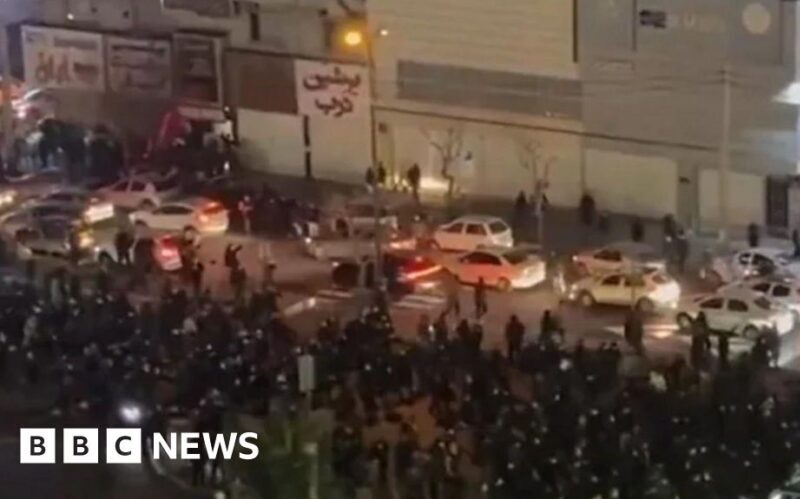
A protest crowd in Tehran, Iran, January 8, 2026
EA on International Outlets: The State of Iran’s Protests
EA-Byline Times Podcast: How Far Can Iran’s Protests Go?
UPDATE 1738 GMT:
Independent media outlets and Internet monitors are warning Iranians to camouflage their Starlink terminals, as authorities search for those evading the regime’s cutoff of communications.
Iranians are also advised not to share their Starlink internet, and to be wary of “social engineering against activists”.
Iranian activists confirmed this morning that Starlink is providing free internet to users in Iran, who number in the tens of thousands.
UPDATE 1131 GMT:
Iranian State media have broadcast at least 97 “confessions” from protesters.
The suspects are handcuffed with their faces blurred. The “confessions” are reinforced with dramatic background music and clips allegedly showing people attacking security forces.
UPDATE 1043 GMT:
The New York Times quotes a Tehran businessman who contacted them by Starlink link Sunday:
I managed to get connected for a few minutes just to say it’s a bloodbath here.
He said the regime’s violent crackdown is “unlike any of the protests that came before”:
I personally saw a young man get shotH in the head. I witnessed someone get shot with a bullet to the knee. The person fell to the ground unconscious, and then security forces gathered over him.
UPDATE 1040 GMT:
Judiciary head Gholamhossein Mohseni-Ejei has called for expedited, public trials of arrested protesters.
Mohseni-Ejei said on a visit to a prison with detained demonstrators, “If a person burned someone, beheaded someone and set them on fire, then we must do our work quickly.”
UPDATE 0912 GMT:
Three doctors have reinforced testimony (see 0752 GMT), of hospitals overwhelmed by protesters shot by security services.
Medical staff told The Guardian that the forces are concentrating on protesters’ eyes and heads, a tactic used against demonstrators in the 2022 Woman, Life, Freedom protests.
An ophthalmologist in Tehran spoke of more than 400 eye injuries from gunshots in a single hospital. Many of the patients have been blinded with eyes removed.
“[Security forces] are deliberately shooting at the head and the eyes. They want to damage the head and the eyes so they can no longer see, the same thing they did in [2022],” said a doctor in Tehran.
Another doctor testified, “It’s like in the war movies where you see the injured soldiers getting treated on the open field. We don’t have blood, we don’t have enough medical supplies. It’s like a war zone. His colleague detailed treatment of injured protesters on the freezing ground outside due to lack of space in hospital wards.
The Tehran physician confirmed that the Internet shutdown prevented him from reaching other doctors and emergency services. Security forces are entering hospitals to arrest injured protesters.
He said, “My colleagues are very distressed, tired and horrified. They are breaking down in tears.”
UPDATE 0825 GMT:
Writer and researcher Azadeh Davachi relays information from Iran’s second city Mashhad:
I have received messages from Mashhad, Iran" the city is under martial law. A curfew has been imposed, and all movement is prohibited after 6:00 PM. The streets smell of blood. Eyewitnesses have told me that a large number of those killed are children under the age of 18.
— azadeh davachi (@azadeh_davachi) January 14, 2026
UPDATE 0752 GMT:
A doctor has spoken with the Center of Human Rights in Iran about the large number of wounded protesters whom he treated between January 6 and 10.
Now outside the country, the physician also witnessed incidents on the streets of Tehran and Isfahan as Iranian security forces escalated its response to include the use of live ammunition and military-grade weapons.
He says the shift from pellet shotguns to close-range gunfire, including with automatic weapons and heavy machine guns, led to mass-casualty conditions in overwhelmed hopsitals. These included an extraordinary number of emergency surgeries for gunshot wounds, particularly severe head, chest, and abdominal injuries. Many victims were dead on arrival.
“My belief is that security forces were told there would be no accountability. No investigations. This was treated as a wartime situation. Go and suppress by any means,” he summarizes.
Security forces in hospitals collected the names, national ID numbers, and personal details of injured patients. Internet, mobile networks, emergency police, fire services, navigation systems, and payment infrastructure were all cut or disabled, obstructing the medical, emergency, and humanitarian response.
The physician says that, in Isfahan alone, hundreds were likely killed over several days. The true toll was impossible to verify under blackout conditions, but those shot ranged from teenagers to elderly men. People were killed simply for being present in public spaces, rather than being part of the protests.
UPDATE, JAN 14:
The US-based Human Rights Activists News Agency says it has verified the deaths of 2,571 people: 2,403 protesters; 147 government-affiliated personnel; 12 children aged under 18; and nine civilian bystanders.
More than 18,100 people have been detained.
UPDATE 1815 GMT:
A protest in Khorramabad in Lorestan Province in western Iran:
این ویدیو تجمع اعتراضی شبهای اخیر در خرمآباد را نشان میدهد که در آن معترضان شعارهای متعددی از جمله «نیروی انتظامی، حمایت، حمایت» و «رضاشاه روحت شاد» میدهند. pic.twitter.com/rGlRdv7Lcz
— BBC NEWS فارسی (@bbcpersian) January 13, 2026
UPDATE 1811 GMT:
Digital rights group Filterbaan says Starlink subscription in Iran is now free.
NasNet, an account promoting Starlink access for Iran, earlier said the service will be available at no cost following weeks of talks between the company and US officials.
UPDATE 1804 GMT:
The US-based Human Rights Activists News Agency has sharply increased the confirmed toll of those killed to at least 2,000 – 1,850 of them protesters.
The rise is in part because of information from Iranians, who can now make calls — but not receive them — outside the country.
UPDATE 1124 GMT:
UN High Commissioner for Human Rights Volker Türk has said:
This cycle of horrific violence cannot continue. The Iranian people and their demands for fairness, equality and justice must be heard.
The killing of peaceful demonstrators must stop, and the labelling of protesters as “terrorists” to justify violence against them is unacceptable.
Turk said it is “extremely worrying” to hear public statements from judicial officials mentioning the prospect of the use of the death penalty against protesters through expedited proceedings.
UN rights office spokesperson Jeremy Laurence say sources in Iran put the death toll in the “hundreds”.
An Iranian official told Reuters that about 2,000 people have been killed during the protests. They did not give a breakdown of who had been slain.
UPDATE 1016 GMT:
Journalist Oliver Darcy reports that Kari Lake, the hard-right Trumpist politician, has blocked US Government-funded Radio Free Europe/Radio Liberty from using a transmitter in Kuwait to broadcast news and protest updates into Iran.
It is unclear why Lake, Acting Director of the US Agency for Global Media, is hindering RFE/RL.
RFE/RL announced over the weekend that it is broadcasting on shortwave through contracts with several commercial vendors rather than the USAGM.
UPDATE 0720 GMT:
Video from an EA correspondent of a protest in Valiasr Square in central Tehran on Monday night:
Footage from a friend of a protest in central #Tehran on Monday night
#IranProtests
— Scott Lucas (@scottlucas.bsky.social) January 13, 2026 at 7:20 AM
UPDATE 0712 GMT:
Iran Wire reports on Ali Dehghan-Joghan, 55, shot in the head and killed by Iranian security forces.
Dehghan Joghan was slain during protests in Tehran last Friday.
A father of two daughters, he was the brother of activist Masoumeh Dehghan and relative of lawyer Abdolfattah Soltani, the co-founder of the Center for Human Rights Defenders in Iran.
UPDATE 0640 GMT:
The Supreme Leader and President Masoud Pezeshkian have each declared the success of regime-organized rallies in pushing back the protests.
State media proclaimed that “millions” of Iranians showed their support in Monday’s gatherings.
The Supreme Leader announced a “historic day” which “foiled the plot of foreign enemies that was to be carried out by domestic mercenaries”.
Pezeshkian echoed Ayatollah Khamenei, saying the “magnificent and epic” rallies neutralized the “sinister designs” of foreign enemies and their “mercenaries”. He expressed deep gratitude for the people’s “steadfastness and authority”.
“I bow before the greatness of your powerful will and authoritative presence,” he said. The marches had made the government “even more determined” to address the country’s challenges from within.
UPDATE, JAN 13:
On the 17th day of nationwide protests, the toll has risen to 646 killed, according to the Human Rights Activists News Agency.
The total includes 505 protesters, including nine under the age of 18; 133 members of military and law enforcement forces; a prosecutor; and seven civilian bystanders.
HRANA is investigating another 579 reports of deaths.
UPDATE 1230 GMT:
A 26-year-old protester, Irfan Soltani, has been sentenced to death with his execution slated for Wednesday, says the Hengaw human rights organization.
Soltani would be the first demonstrator hanged during the 16-day nationwide protests.
UPDATE 1027 GMT:
Iranian police are sending text messages to Tehran residents warning parents to keep their children away from protests:
Given the presence of terrorist groups and armed individuals in some gatherings last night and their plans to cause death, and the firm decision to not tolerate any appeasement and to deal decisively with the rioters, families are strongly advised to take care of their youth and teenagers.
Protesters say authorities are cutting off electricity before attacking.
A demonstrator in the Punak neighbourhood of Tehran said:
After some time, in the darkness, gunfire began and people were hit by bullets. There were no security forces present in the streets. Based on what we observed, we suspect the shots were fired either from drones in the sky or directly from rooftops.
UPDATE 0928 GMT:
The award-winning film director Jafar Panahi has dedicated his latest accolade to Iranians.
1. The legendary Iranian filmmaker Jafar Panahi dedicated his New York Critics award to the people of Iran.
Keep in mind that after the Golden Globes, Panahi — who has already served time in prison — is returning to Iran, where he is set to serve out another prison sentence.
— Yashar Ali (@yasharali.bsky.social) January 11, 2026 at 11:27 PM
UPDATE 0834 GMT:
The BBC has counted around 180 body bags in footage from a morgue in Kahrizak near Tehran.
A witness in Tehran said Sunday:
Things here are very, very bad. A lot of our friends have been killed. They were firing live rounds. It’s like a war zone, the streets are full of blood. They’re taking away bodies in trucks.”
UPDATE 0737 GMT:
Iranian journalist Omid Memarian has posted testimonies from “young professionals” inside the Iran.
One of them says:
The number of people injured and killed across different cities is unprecedented. In Mashhad, many people were taken to hospitals. One doctor told me that medical staff were stunned and in tears while treating the wounded and seeing bodies brought in. In Hamedan as well, many people have been killed during recent demonstrations. I heard this directly from people who were themselves present at the protests. The same is true in Tehran and many other cities. The government is deeply frightened and feels its survival is at risk.
Another adds, “The absence of anyone people trust — someone whose words could guide next steps — is very clear. The lack of leadership and organization has left the future of the protests uncertain. But regardless, people are determined to come to the streets day after day.”
The witnesses emphasize the “extraordinary” range of protesters — women and girls as well as men — with “many older people” who “want to stand alongside the younger generation”.
You need to understand this: the economic situation is unbearable for a large segment of the population. Almost everyone participating in the protests believes that — whether the issue is economic or political — nothing will be resolved unless the government is removed and the regime falls. Nothing short of that will satisfy people. At the same time, no one really knows what will happen next. The anger and rage the government has produced are unprecedented.
Scattered notes from conversations with several people who took part in the protests over the past few days. These conversations happened in brief windows when they could connect outside Iran using VPNs. I’ve grouped their remarks here.
Obviously, none of them were in a position… pic.twitter.com/wiTyOofjDm
— Omid Memarian (@Omid_M) January 11, 2026
UPDATE, JAN 12:
On their 16th day, protests continue across Iran despite the rising death toll, including from killings by security forces.
At least 538 people have been slain, including 490 protesters,according to the US-based Human Rights Activists News Agency, including 490 protesters. More than 10,600 people have been detained.
Despite the regime’s cutoff of the Internet last Thursday, messages continue to trickle out, including of the use of live ammunition by security forces and bodies stacked up in morgues and even prayer rooms.
A protester in Sari in central Iran said security forces have placed the city under martial law.
Student Rubina Aminian, 23, was shot in the head “from close range”, said the Norway-based Iran Human Rights.
Aminian attended Shariati College in Tehran, studying textile and fashion design. She was killed last Thursday when she joined a protest after leaving the college.
A “source close to the family” said Rubina’s relatives finally retrieved her body from authorities, returning to Kermanshah in western Iran. However, intelligence forces surrounded their home and they were not allowed to give her a proper burial.
The family was “forced to bury her body along the road” between Kermanshah and nearby Kamyaran.
Protesters in the Punak district of Tehran on Sunday night:
ویدیوی رسیده به ایراناینترنشنال نشان میدهد شامگاه یکشنبه به رغم سرکوب و قطع اینترنت مردم تهران در منطقه پونک تجمع کرده و آتش روشن کردند و شعار اعتراضی دادند. pic.twitter.com/gq6DPYIdj4
— ايران اينترنشنال (@IranIntl) January 11, 2026
Trying to rally support, the regime has declared three days of mourning for “martyrs”.
Iranian State and semi-official media claim 109 security personnel have been killed, including 30 police and security officers in Isfahan Province in central Iran and six in Kermanshah in the west.
A protester shouts in Iran’s second city Mashhad, “They are shooting at people. Help us”:
“They are shooting at people. Help us,” a protester shouts in English on the streets of Mashhad in northeastern Iran in a video sent to Iran International, appealing for help from the United States. pic.twitter.com/XGd5Ork3XT
— Iran International English (@IranIntl_En) January 11, 2026
UPDATE 1947 GMT:
Through his spokesperson Stéphane Dujarric, UN Secretary-General António Guterres said he “is shocked by the reports of violence and excessive use of force by the Iranian authorities against protesters”.
He called on the authorities “to exercise maximum restraint and to refrain from unnecessary or disproportionate use of force”.
UPDATE 1943 GMT:
At least 490 protesters and bystanders have been killed by Iranian security forces and more than 10,000 people detained, reports the Human Rights Activists News Agency.
UPDATE 1536 GMT:
The Hengaw Organization for Human Rights says it has verified videos confirming the killings of civilians by Iranian military and security forces in Tehran.
The footage was likely recorded near the Kahrizak forensic medicine and morgue facilities, says Hengaw. It shows armed government forces opening direct fire with live ammunition against civilians.
Another video shows rows of bodies of victims inside a warehouse hall at the Kahrizak morgue, with families searching for and identifying relatives.
“Informed sources at the site” told Hengaw, “Dozens of bodies are being held at Kahrizak, all of whom were killed by live ammunition….The morgue is so overcrowded that bodies are also being kept in adjacent warehouse halls.”
Despite restrictions on communications, Hengaw says it has obtained the preliminary identities of at least ten Kurdish civilians killed in Tehran by government forces.
UPDATE 1526 GMT:
President Masoud Pezeshkian has adopted a harder line after calling earlier in the protests for dialogue: “People have concerns, we should sit with them and if it is our duty, we should resolve their concerns. But the higher duty is not to allow a group of rioters to come and destroy the entire society.”
Iran Police Chief Ahmad-Reza Radan claimed on State TV, “Last night, significant arrests were made of the main elements in the riots, who, God willing, will be punished after going through legal procedures.”
UPDATE 1359 GMT:
Iranian State and semi-official media claim 109 security personnel have been killed, including 30 police and security officers in Isfahan Province in central Iran and six in Kermanshah in the west.
The Iranian Red Crescent Society said a staff member was slain during an attack on one of its relief buildings in Gorgan, the capital of Golestan Province in northeast Iran.
UPDATE 1354 GMT:
Journalist Sima Sabet passes on a message from inside Iran:
I barely managed to connect to the internet using a Starlink. The situation in Iran is extremely strange. We have absolutely no access to anything. Even mobile banking barely works, and only on certain networks….SMS messages don’t send or receive at all. Even bank one-time passwords often don’t arrive. Regular phone calls barely work. Even the regime’s own messaging apps like Baleh and Eitaa have disabled message sending.
State TV is constantly calling the protesters “armed terrorists”. Text messages keep coming saying that because the terrorists are armed, people should not go out during busy hours because the police will show no leniency.
Most shops are empty. Chain stores have no meat or chicken, and the excuse is that they’ve just issued food vouchers and people bought everything.
UPDATE 1315 GMT:
While proclaiming that Iran recognizes people’s peaceful protests over economic concerns, Parliament Speaker Mohammad Baqer Qalibaf has portrayed demonstrators as “terrorists”.
He told the chamber, “Today, the Iranian nation has decided firmly to stand against armed terrorists….We will recognize rightful protests and will seriously investigate them.
Qalibaf declared that Iran is fighting on four fronts — economic, cognitive, military, and terrorist — in wars with the US and Israel. He said the two countries began their “terrorist war” after the supposed defeat of Israel in its 12-day war last June.
Those who openly call themselves foreign mercenaries, betraying their own homeland to appease the US President and transforming into Daesh [Islamic State] operatives, and initiating a terrorist war – let them know that we will confront them with the most severe measures.
Those we apprehend will be punished, and those armed will face a harsh and uncompromising response.
UPDATE 1257 GMT:
Staff at several Iranian hospitals have told the BBC their facilities are overwhelmed with dead or injured patients.
A hospital worker described “very horrible scenes”, with so many wounded that staff did not have time to perform CPR:
Around 38 people died. Many as soon as they reached the emergency beds…Direct shots to the heads of the young people, to their hearts as well. Many of them didn’t even make it to the hospital.
The number was so large that there wasn’t enough space in the morgue; the bodies were placed on top of one another.
After the morgue became full, they stacked them on top of one another in the prayer room….
Couldn’t look at many of them, they were 20 to 25 years old.
A doctor who contacted the BBC via a Starlink satellite connection said Tehran’s main eye specialist centre, Farabi Hospital, has gone into crisis mode. Non-urgent admissions and surgeries were suspended and staff called in to deal with emergency cases.
Security forces often aim at the eyes of demonstrators.
Another doctor from Kashan in central Iran told the BBC many injured protesters had been hit in the eyes. A doctor at a medical center in Tehran explained:
The number of injured people and fatalities was very high. I saw one person who had been shot in the eye, with the bullet exiting from the back of his head.
Around midnight, the centre’s doors were closed. A group of people broke the door and threw a man who had been shot inside, then left. But it was too late – he had died before reaching hospital and could not be saved.
A medic at a hospital in Shiraz in southwest Iran said large numbers of injured were being brought in, and the hospital did not have enough surgeons to cope with the influx.
UPDATE 1252 GMT:
Video of Saturday night’s protest in Tehran’s Kishaye Street — slogans include, “This year is the year Seyed Ali [the Supreme Leader] is overthrown”:
کانال تلگرامی وحیدآنلاین ویدیویی از اعتراضات در خیابان گیشای تهران را در شامگاه ۲۰ دی به وقت محلی منتشر کرده که حضور معترضان در خیابانها را نشان میدهد.
در این ویدیو سطلهای زباله شهری واژگون شده در وسط خیابان به چشم میخورد که بعضی از آنها دارند میسوزند و شعارهایی از جمله… pic.twitter.com/T4ymnVGrgk
— BBC NEWS فارسی (@bbcpersian) January 11, 2026
UPDATE 0825 GMT:
A traveller who left Iran on Saturday reports, “Mobile networks are completely shut down from around nighttime until about 8 a.m. the next day.” Internet access to sites outside Iran is cut, but “from around 8 a.m. until evening, the national intranet functions”.
It is not possible to make phone calls abroad.
He said, “On Thursday, Enghelab Street [a main thoroughfare in Tehran] was so crowded that the beginning and end of the crowd were impossible to see. On Friday, the crowd was far, far larger, to the point that even people who had been out the night before could not believe it.”
By Friday night, “many areas of Tehran were effectively in the hands of the people because security forces were spread too thin”.
When you talk to people, the majority say there is truly no room to back down this time, because if the regime gets past this stage, there will be a massacre.
Teenagers and young people have risen up in force. Their bravery is unbelievable. Street-level leadership is effectively in their hands, although many middle-aged and older people are also visible in the crowds.
He summarized, “Every type of person is out in the streets: office workers, bazaar merchants, factory owners, laborers, students, retirees, and more.”
UPDATE, JAN 11:
There were more than 570 protests across all of Iran’s 31 provinces on Saturday, reported the US-based Human Rights Activists News Agency.
Iranian authorities showed their concern with more threats against the demonstrators. Attorney General Mohammad Mahvadi Azad, said any protester will be considered an “enemy of God”, a charge which carries the death penalty. State TV added that anyone who assists demonstrators could be prosecuted.
HRANA said that at least 116 people have been killed in the violence and more than 2,600 detained.
Healthcare staff in Tehran and in Rasht in northern Iran told the BBC that their hospitals’ morgues have been full over the past two nights. Corpses were piled up for hours in the prayer room and on the morgue floor.
In eastern Tehran, several families have broken the locks on the morgue and ambulances to prevent bodies from being taken away by authorities.
A protester in Tehran told The Guardian, “We’re standing up for a revolution, but we need help. Snipers have been stationed behind the Tajrish Arg area [a wealthy neighbourhood in Tehran]….We saw hundreds of bodies.”
Another activist in Tehran said they had witnessed security forces firing live ammunition at protesters with a “very high” number killed. Human rights activists said the claims of police brutality are consistent with testimony they have received.
Footage from Iran’s second city Mashhad:
ویدئوهای دریافتی از مشهد نشان میدهد که شب گذشته، ۲۰ دی، مشهد صحنه تظاهرات و درگیری معترضان با نیروهای امنیتی است. https://t.co/ZXEN8CyaNr pic.twitter.com/Ox2hbDkN0n
— BBC NEWS فارسی (@bbcpersian) January 11, 2026
UPDATE 1233 GMT:
Video from Friday night’s protests in Iran’s second city Mashhad — slogans include “This is not the last battle, the Pahlavis will return” and “Long live the Shah”:
ویدیوهایی از اعتراضات جمعه ۱۹ دی از شهر مشهد در استان خراسان منتشر شده که حضور گسترده مردم و ماشینها را نشان میدهد.
در این ویدیوها فردی دیده میشود که در تلاش است تا دوربین مداربسته نظارت ترافیک در یک بزرگراه را از جا در آورد و شعارهایی از جمله «این آخرین نبرده، پهلوی برمی… pic.twitter.com/JIcepZZCge
— BBC NEWS فارسی (@bbcpersian) January 10, 2026
The scene in Yazd in central Iran on Beheshti Boulevard, in Imam Hossein Square, and in front of the Yazd Provincial Relief Committee building:
تصاویر تجمع دیشب ۱۹ دی ۱۴۰۴ از یزد نشان میدهد مردم در بلوار بهشتی، میدان امام حسین و روبهروی ساختمان کمیته امداد استان یزد با شعارهای «جاوید شاه» و «این آخرین نبرده، پهلوی برمیگرده» اعتراض خود را نشان میدهند. pic.twitter.com/gZuatQ2WTh
— BBC NEWS فارسی (@bbcpersian) January 10, 2026
And in Tabriz in northwest Iran:
تصاویری از اعتراضات شبانه ۱۹ دی ۱۴۰۴ در تبریز منتشر شده است. ویدیوهای منتشر شده نشان میدهد معترضان با شعارهایی از جمله « آذربایجان شرف دی، سیدعلی بیشرف دی»٬ «یاشاسین پهلوی»٬ «مرگ بر دیکتاتور» و «امسال سال خونه٬ سید علی سرنگونه» اعتراض خود را به حکومت جمهوری اسلامی اعلام میکنند pic.twitter.com/59GWW3idbh
— BBC NEWS فارسی (@bbcpersian) January 10, 2026
UPDATE 1127 GMT:
Ali Hamedani, the director of the UK-based Persian Mix Radio, has spoken with a journalist in Tehran through Starlink.
“Mobile networks and most landlines are down, making phone calls, even to emergency services, impossible,” the journalist says. “ATMs and card machines are not working. People are in need of cash.”
As gunfire was heard in the distance, he suggested the number of protesters was higher than on Thursday night and “a very large number of people were almost certainly killed”.
The Supreme Leader’s speech, calling protesters “saboteurs”, is being broadcast over loudspeakers, but residents are responding with chants of “Javid Shah” [God Save The King].
UPDATE, JAN 10:
An EA correspondent sends videos of large protests overnight on Dollat Street, a major street in northern Tehran, and in the city of Karay.
He summarizes concisely, “Many people in all cities are protesting.”
Amid a large protest in the Punak neighborhood of Tehran, a demonstrator writes “Long live the Shah” on an advertising billboard:
ویدیویی از حضور گسترده معترضان در محله پونک تهران در شامگاه ۱۹ دیماه در شبکههای اجتماعی مورد توجه قرار گرفته است. در این ویدیو، معترضی را میبینیم که شعار «جاوید شاه» را روی یک بیلبورد تبلیغاتی مینویسد.
منبع: vahidonline pic.twitter.com/8ffeIKRoxp
— BBC NEWS فارسی (@bbcpersian) January 10, 2026
Another march in Tehran with chants of “Neither Gaza, nor Lebanon, my life for Iran” and “Support, support, for the honorable Iranian” — a demonstrator says, “If you can, come and kill this crowd”:
In this video, the chants “Neither Gaza, nor Lebanon, my life for Iran,” “This is the final battle, the Pahlavi will return,” and “Support, support, for the honorable Iranian” can be heard.
ویدیویی از راهپیمایی اعتراضی در پاسداران تهران در ۱۹ دیماه منتشر شده است.
یک معترض در این ویدیو با اشاره به جمعیت بالای معترضان میگوید : «اگر میتوانید بیایید این جمعیت را بکشید».در این ویدیو، شعارهای «نه غزه، نه لبنان، جانم فدای ایران»، «این آخرین نبرده، پهلوی برمیگرده» و… pic.twitter.com/7MDYAknfpD
— BBC NEWS فارسی (@bbcpersian) January 9, 2026
The International Federation of Journalists has criticized the cutoff of the Internet and phones by Iranian authorities as “a deliberate attack on media freedom”.
Anthony Bellanger, the IFJ’s Secretary-General, said, “Journalists are prevented from doing their work, news sources fall silent, and during national unrest, people are deprived of vital information.”
The IFJ called on the Islamic Republic to “immediately restore full access to the Internet so that journalists can report freely and people can enjoy the right to access information.”
UPDATE 1852 GMT:
The toll of protesters and bystanders killed by security forces has risen to at least 51, including nine children, according to the Norway-based Iran Human Rights Organization.
Maryam, a 25-year-old artist who protested in Tehran early Friday said:
They’re aiming for the eyes. The Faraja [uniformed police], the Basij [paramilitary militia] and even plainclothes kill-squads are driving into the crowds with motorbikes.
I don’t know how long the internet will be working but we are thousands on the streets and I fear I will wake up to hundreds of casualties.
Hossein, a 22-year-old university student, explained how demonstrataors were trying to bypass the cutoff of the Internet by Iranian authorities: “Since June, we have been trying several ways to find these ‘secret tunnels’ that can route our messages outside the country. A group of us are able to still chat but I can see mobile lines are also getting disrupted.”
Iranian State media finally acknowledged the protests, declaring the protests are violent riots instigated by “terrorist agents” of the US and Israel. Press TV claimed that an Israeli spy cell was planning a “false-flag killing operation aimed at blaming the state for civilian deaths”.
Speaking in Beirut, Lebanon, Foreign Minister Abbas Araghchi pushed the message:
The protests that are happening in Iran of course are different from protests in other countries because of US and Israeli interventions in the protests. You need to look at all the statements from the US and Israel to see how they are interfering.
Farzad, a 37-year-old mobile shop owner in Rasht in northern Iran, responded: “They are vulgar and are saying we are in bed with the Israelis and Americans. They call us traitors. It’s them that have betrayed the very sense of being an Iranian.”
UPDATE 1226 GMT:
In remarks aired on State TV, the Supreme Leader has portrayed protesters as foreign-backed “saboteurs”: “Everyone should know that the Islamic Republic came to power with the blood of hundreds of thousands of honorable people, and it will not back down in the face of saboteurs.”
He said of demonstrators, “They want to make [Donald Trump] happy. If he knew how to run a country, he would run his own.”
Trump should know that world tyrants such as Pharaoh, Nimrod, Reza Shah, and Mohammad Reza were brought down at the peak of their arrogance. He too will be brought down.
Iran saw its largest protests to date on January 8 with crowds flooding streets in major cities, small towns, and neighborhoods across Tehran. Eyewitnesses said the police was using tear gas, and an Internet blackout was widely reported. pic.twitter.com/ZtHawFgTuB
— Radio Free Europe/Radio Liberty (@RFERL) January 9, 2026
UPDATE 1219 GMT:
Protesters in Zahedan in southeast Iran have reportedly been injured by security forces.
The forces reportedly used tear gas and shotgun pellets on the demonstration after Friday Prayers.
منابع حقوق بشری در ایران گزارش کردهاند که همزمان با برگزاری نماز جمعه امروز ۱۹ دی در زاهدان شماری از شهروندان بلوچ با حضور در خیابانهای اطراف مسجد مکی به اعتراضات پیوستند که با برخورد نیروهای نظامی و امنیتی روبرو شدند.
کانال حالوش که اخبار سیستان و بلوچستان را پوشش میدهد با… pic.twitter.com/mGhL36bnuZ
— BBC NEWS فارسی (@bbcpersian) January 9, 2026
ORIGINAL ENTRY, JAN 9: Iran’s authorities cut the Internet on Thursday night amid mass demonstrations in cities on the 12th day of nationwide protests.
The protests and strikes began over economic conditions, notably the collapse of the national currency, but have turned into a challenge to the rule of the reigme.
The monitor NetBlocks first reported outages in Kermanshah in western Iran during the day. By night, access had been almost completely shut down through the Islamic Republic.
The toll has risen to at least 45 killed, including eight children, as security forces try to disperse the gathering, according to the Norway-based NGO Iran Human Rights. Wednesday was the bloodiest day so far, with 13 protesters confirmed killed. IHR said hundreds more have been wounded and more than 2,000 arrested.
Amnesty International summarized, “Iran’s security forces have injured and killed both protesters and bystanders.”
Anti-regime protests gaining momentum throughout Iran. Most common slogans:
-“Death to the dictator” (marg bar diktator)
-“Long live the Shah" (Javid Shah)
-“Freedom” (Azadi)
-“This is the last battle, Pahlavi will return" (een akhareen nabarde, Pahlavi barmigarde) via @Vahid pic.twitter.com/PMSUMbOrx5— Karim Sadjadpour (@ksadjadpour) January 8, 2026
More shopkeepers joined a general strike after calls from seven Kurdish groups, shutting in Kurdish regions and dozens of other cities and provinces such as Ilam, Kermanshah, and Lorestan. Claims circulated of firing on demonstrators in Kermanshah and the nearby town of Kamyaran to the north, injuring several demonstrators.
By the end of Thursday, large crowds were gathering in Tehran, including on the wide Ayatollah Kashani Boulevard in the northwest of the capital, as vehicle drivers honked horns in support.
In Fars Province in southern Iran, protesters pulled down the statue of the regime’s icon, Gen. Qassem Suleimani. The long-time commander of the Quds Force, the branch of the Revolutionary Guards operating outside Iran, Soleimani was assassinated by the US almost exactly six years ago.
The scene in Isfahan in central Iran, as the headquarters of State broadcaster IRIB was reportedly set ablaze:
Iran saw its largest protests to date on January 8 with crowds flooding streets in major cities, small towns, and neighborhoods across Tehran. Eyewitnesses said the police was using tear gas, and an Internet blackout was widely reported. pic.twitter.com/ZtHawFgTuB
— Radio Free Europe/Radio Liberty (@RFERL) January 9, 2026
The Fars News Agency, the outlet of the Revolutionary Guards, said a members of the security forces was killed west of Tehran trying “to control unrest”. Regime Outlets close to the government said a police colonel was stabbed outside Tehran, while a police station in Chenaran, north-east of Tehran, was attacked on Wednesday night leading to the death of five people.
Iranian President Masoud Pezeshkian called for “utmost restraint” by security personnel: “Any violent or coercive behaviour should be avoided.” He urged the regime to pursue “dialogue, engagement. and listening to the people’s demands”.

HRANA reports new death toll: https://www.en-hrana.org/sixteenth-day-of-protests-families-of-victims-gather-at-behesht-zahra-cemetery-as-total-communications-blackout-continues/
• 505 protesters have been killed.
• Among them, Nine children (under the age of 18) have been identified.
• 133 members of military and law enforcement forces have been killed.
• One non-military government affiliate (a prosecutor) has died.
• Seven of those killed were non-protesting civilian citizens.
I am truly shocked that HRANA is reporting more security forces killed than even Tasnim has done.
[Editor’s Note: The line from Iran State media….]
Millions of Iranians rise against Terrorists: https://x.com/TehranTimes79/status/2010748626516283719/photo/1
It seems the Internet will gradually be lifted over the next few days, starting with most media.
There are reports of people being shot from roof tops, and by drones.
That is a new level of legitimacy for iri.
What did khomeini was going to achieve in the revolution??? Well they have, this is the islam they were hoping for establish, imam hossein’s way is complete.
Iran mobilises mass rallies and says US and Israel fuelling protest violence: https://www.middleeasteye.net/news/iran-blames-us-and-israel-unrest-tehran-says-protests-are-under-control-0
“Tehran claims street ‘under control’: Pro-government demonstrations swept across several Iranian cities on Monday as authorities sought to blunt more than two weeks of nationwide protests.State media reported large rallies in multiple provinces, while Al Jazeera said “tens of thousands” gathered in Tehran. Officials also announced another mobilisation at Ngalabi Square, a frequent venue for state-backed gatherings.”
Iran Declares Three Days of National Mourning Following Recent Violence: https://www.tasnimnews.com/en/news/2026/01/12/3492611/iran-declares-three-days-of-national-mourning-following-recent-violence
This is the video from a mortuary that HRANA is using to claim 250 people were killed in Tehran: https://www.en-hrana.org/wp-content/uploads/2026/01/day-15-protest.mp4?_=1
People are living the horror on the streets and see it with their own eyes, you can’t scare them further
109 security officers reported killed by Iran State media: https://www.aljazeera.com/news/2026/1/11/iran-says-dozens-of-officers-killed-as-protesters-defy-government-crackdown
Meanwhile, Iran International is claiming 2,000 have been killed over the past 48 hours: https://www.iranintl.com/en/202601103903
“109 security officers reported kille…”
They had existing medical conditions what does it have to with protesters.
HRANA’s latest figures: https://www.en-hrana.org/day-fourteen-of-protests-ongoing-demonstrations-internet-blackouts-and-drone-surveillance/
116 killed of whom 74 are protesters/rioters, 37 are security officers, 4 bystanders (including a nurse and a toddler) and 1 government agent (a judicial official). 2,638 arrests so far.
Iranian officials claim that in just two provinces, Fars and Esfahan, 42security officers have been killed: https://www.presstv.ir/Detail/2026/01/11/762180/30-security-forces-killed-in-foreign-backed-riots-in-Isfahan
[Editor’s Note: Claim from Iran semi-official outlet close to regime leadership]
Field Report: Calm in Most Parts of Tehran on January 10: https://www.tasnimnews.com/fa/news/1404/10/20/3491901
“Field observations by Tasnim News Agency reporters indicate that the intensity of the disturbances has decreased compared to previous nights, and most of the main and central parts of Tehran have had a quiet night tonight.”
Tehran is as calm as it has ever been: https://www.tasnimnews.com/fa/news/1404/10/20/3491896
[Editor’s Note: The first link is from Iran State media….]
Calm returns after riots, deadly attacks on security forces: https://www.presstv.ir/Detail/2026/01/10/762144/Calm-returns-after-riots,-deadly-attacks-on-security-forces
“Iran’s national police spokesman says field observations indicate calm has returned to cities across the country following a wave of riots, as senior officials said armed groups, foreign-backed elements and terrorist actors were orchestrating violence, arson attacks and assaults on public infrastructure.”
HRANA claims that 65 persons have been killed, of whom 14 are security force members and another a government agent. More policemen and Basij members were killed overnight so this is not up to date: https://www.en-hrana.org/day-thirteen-of-the-protests-nighttime-demonstrations-continue-amid-internet-shutdown/
The BBC Persian has only confirmed the deaths of 22: https://www.bbc.co.uk/news/live/clyzjn0w9l2t
The scale of the destruction is slowly trickling in despite the internet shutdown [Editor’s Note: This is a semi-official Iran outlet]: https://x.com/MehrnewsCom/status/2009849256086040843
Mosques, banks, government buildings and police stations have all been attacked and burned.
You sound like frightened little boy in forest singing to himself, reza
Protesters take to the streets of Iran for 13th consecutive night
https://www.iranintl.com/en/liveblog/202601054803