
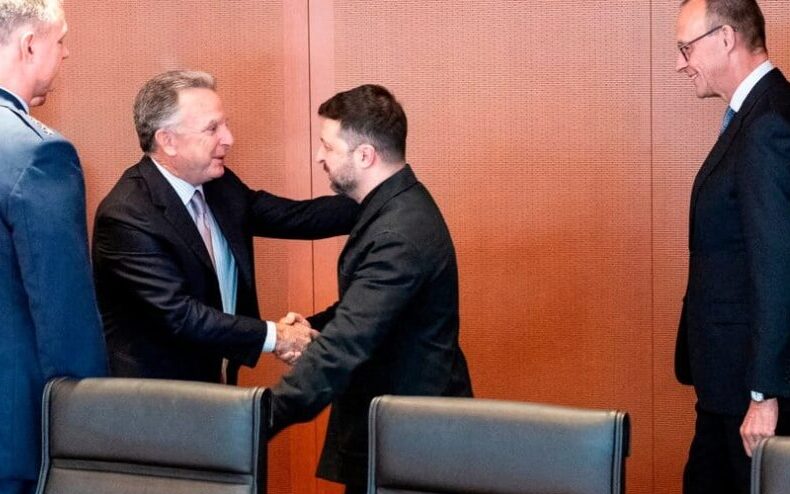
Ukraine President Volodymyr Zelensky shakes hands with Donald Trump’s envoy, real estate developer Steve Witkoff, as German Chancellor Friedrich Merz (R) looks on, Berlin, December 14, 2025
EA VideoCasts with Times Radio and War and Politics 24: Why The Defense of Ukraine Matters
UPDATE, DEC 16:
Just before the Berlin talks finished with significant progress for Ukraine and Europe, I spoke with Pakistan TV’s Sana Maqbool on Tuesday about the state of the discussions.
I lay out the key issues, including territory and security guarantees; the split with the Trump Administration; and the need for Europe and the international community to maintain support for Ukraine’s resistance.
ORIGINAL ENTRY, DEC 15: I joined Dublin NewsTalk’s Pat Kenny Show and Poland’s TVP World on Monday of the two-day talks between Ukraine President Volodymyr Zelensky, European partners, and Donald Trump’s envoys and Kremlin collaborators Steve Witkoff and Jared Kushner.
I set out the differences between the Witkoff-Kushner proposal, developed with Vladimir Putin’s top economic advisor Kirill Dmitriev, and the European counter-proposal.
In particular, I consider whether Zelensky and the Europeans can resist the demands for Ukraine’s withdrawal from the Donetsk region and limits on Ukrainian sovereignty and its military.
Listen to Pat Kenny Show
In a 15-minute analysis, I detail the Witkoff-Kushner collusion with the Krmelin. I consider their motive, as well as that of Vice President J.D. Vance and Donald Trump, in forcing a Ukrainian capitulation.
In single word: Money.
I look at the options of Zelensky and Europe, given that others in the Trump Administration — notably Secretary of State Marco Rubio and career officials — are not happy with the alignment with Moscow. Can they establish a ceasefire on the frontlines and security guarantees for Kyiv?
The barrier to that? Vladimir Putin. He is not interested in a ceasefire. He told Indian media, “We will get the rest of the Donetsk region, whether by negotiation or force. Ukraine will be kept militarily restricted.
The Kremlin is saying, “We are not interested in compromise. Accept our conditions or we continue the attacks.”
I also discuss the Trump Administration’s seizure of a Venezuelan tanker. And I look at FBI Director Kash Patel, politically exploiting a mass killing at Brown University, ruining the reputation of an innocent man.
Watch TVP World
Our 10-minute conversation begins with an international conference trying to establish Russian reparations for the damage which Moscow has caused in its full-scale invasion.
I then examine the state of the Berlin talks and reiterate the necessity for Europe, given the Trump Administration’s abandonment of alliance, to stand up for its security as well as that of Ukraine.

A viable, dynamic and diversified economic system able to attract foreign investment can sustain a major defense industry for Europe. Those pre-requisites are not there for Europe now, especially if it shakes the confidence of extra-regional investors by illegally seizing Russia’s assets. Europe continues to flirt with the ideal of seizing assets, to de-industrialize and ween itself off from Russian gas and fertilizer. No good fortune will come to Europe if this policy of perpetual conflict with Moscow is pursued. And no viable and sensible economic and security policy is possible if peaceful co-existence with Russia is not a policy objective. So, Europe should do the following: fill the security vacuum left by the US by implementing pragmatic and rational economic and security policies, pursue a rapprochement with Russia by building on the established institutions — OSCE, Council of Europe, etc.). It has been said that, when it comes to security in Europe, all roads lead to Moscow. Professor Lucas knows this. Boris Yeltsin said that the Cold War had been replaced with a cold peace. Europe should not want a hot war in Ukraine, and it should not be satisfied with the return of a cold peace. Why not make Boris Yeltin’s dreams of a warm peace and a fair and unbiased European security framework come true? If the US elephant leaves the room, the possibilities can be freely explored and debated both at the governmental level and in European public discourse.