
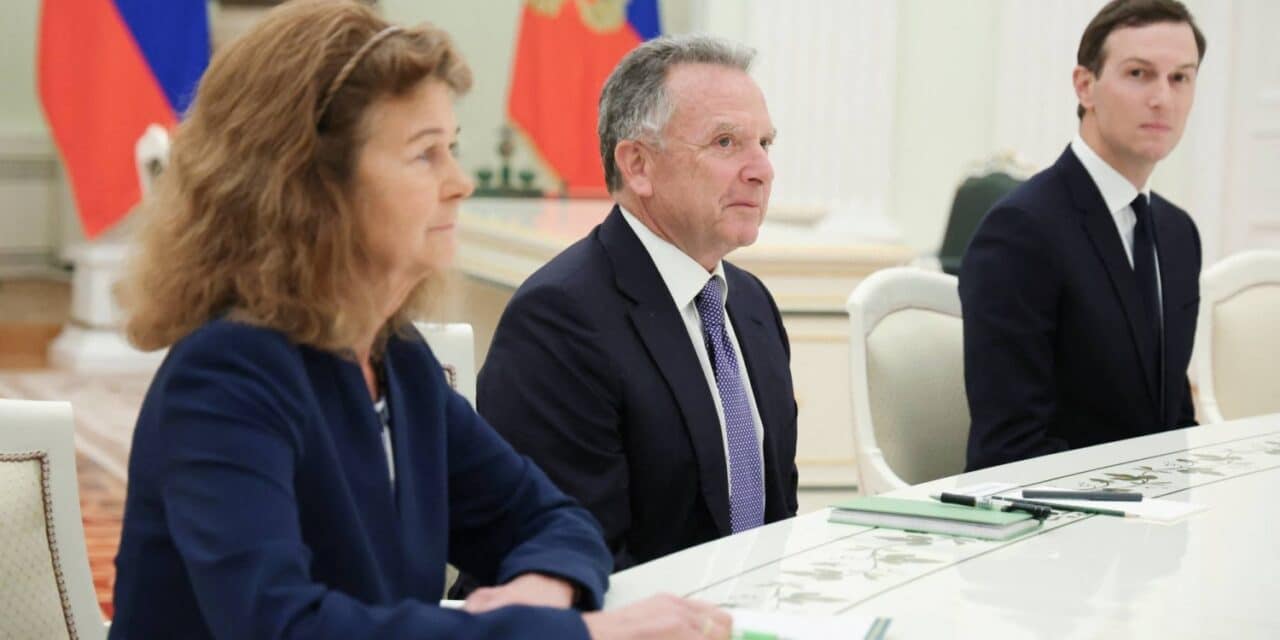
Real estate developer Steve Witkoff (C) and Donald Trump’s son-in-law Jared Kushner (R) with a translator in their Kremlin meeting with Vladimir Putin, Moscow, Russia, December 2, 2025
EA-Times Radio VideoCast: Witkoff and Kushner Confer with the Kremlin
EA on RTE: Real Estate Developer and Trump’s Son-in-Law Visit Putin
EA on RTE: Zelensky in Ireland
Tuesday’s Coverage: Witkoff and Kushner in the Kremlin
UPDATE 1508 GMT:
European Commission President Ursula von der Leyen has presented plans to cover two-thirds of Ukraine’s finances for 2026-2027 – around €90 billion ($105 billion) – with the rest to be provided by international partners.
The EU contribution will be funded through borrowing on capital markets and the use of cash balances from frozen Russian assets as a “reparations loan”.
She said there will be “very strong safeguards” in place to make sure the funds are used in the right way. Belgium, which holds 2/3rd of the frozen assets, will be protected from any legal action.
“We will share the burden in a fair way,” Von der Leyen assured. “It’s very important that we accommodate all the concerns and perceived risks.”
However, she indicated that the measures would not require unanimity and could be adopted by a qualified majority.
Belgium blocked adoption of the “reparations loan” in October. Foreign Minister Maxime Prévot said earlier on Wednesday that the reparations loan is “the worst of all” options, as “it is risky [and] has never been done before”.
He said Belgium is frustrated with “not being heard” and having its concerns “downplayed”: “The text the Commission will table today does not address our concerns in a satisfactory manner. It is not acceptable to use the money and leave us alone facing the risks.”
With today's proposals, we can give Ukrainians the means to defend themselves.
And take forward peace talks from a position of strength.
We are putting forward solutions to support Ukraine's budget and strengthen its defence industry ↓ https://t.co/rVwJoZEOEy
— Ursula von der Leyen (@vonderleyen) December 3, 2025
Ukraine Prime Minister Yulia Svyrydenko welcomed Von der Leyen’s announcement:
A stable, predictable, and justice-based approach gives our people confidence, protects essential public services, and strengthens Ukraine’s path toward full European integration. It also reaffirms a fundamental truth: aggression must never be rewarded, and accountability must remain central to Europe’s response.
Today’s decision by the European Commission to advance a framework for long-term financing for Ukraine, including the option of the Reparations Loan, is an important and responsible step forward.
I sincerely thank President @vonderleyen, Commissioner @VDombrovskis, and the…
— Yulia Svyrydenko (@Svyrydenko_Y) December 3, 2025
UPDATE 1339 GMT:
Ukraine has again struck the Druzhba oil pipeline from Russia to Hungary and Slovakia.
The pipeline, with a capacity of 2 million barrels per day, was attacked on Monday in the Tambov region in southwest Russia, confirmed a Ukrainian military intelligence official.
Remote-controlled explosives, combined with additional combustible mixtures, were used.
“The Russian oil network, as the main source of income for the aggressor state and financing for the military-industrial complex, will continue to explode and burn until the enemy stops trying to attack Ukraine,” the official said.
Ukraine attacked the pipeline on several occasions in August. The strikes brought sharp protests from Hungary and Slovakia, both of whom have leaders sympathetic to the Kremlin.
The Druzhba oil pipeline has exploded in Russia, sources in Ukraine's Main Intelligence Directorate report. Remote-controlled explosives with additional combustible mixtures were used to destroy the pipeline section.
hormadske pic.twitter.com/5Gf3fa0PWP— Euromaidan Press (@EuromaidanPress) December 3, 2025
UPDATE 1218 GMT:
Vladimir Putin’s foreign policy advisor Yuri Ushakov gives an account of the Kremlin’s hosting of Trump envoys Steve Witkoff and Jared Kushner:
We agreed that at the level of representatives and assistants, we will continue contacts with the Americans, in particular with these two people.
As for a possible meeting at the Presidential level, that will depend on what progress we can achieve along this path.
Putin kept Kushner and Witkoff for almost three hours as he delivered a speech at the “Russia Calling!” forum.
UPDATE 1205 GMT:
Canada is committing an additional $200 million to purchase US weapons for Ukraine.
Foreign Minister Anita Anand announced the pledge, under the Prioritised Ukraine Requirements List, ahead of a NATO ministerial meeting in Brussels.
The new contribution brings Canada’s total commitment under the PURL program to $890 million.
Norway’s Foreign Minister Espen Barth Eide said Oslo will contribute an additional $500 million.
“The situation demands a major increase in support to ensure Ukrainians could negotiate from a position of strength,” Eide said.
Norway’s contribution is part of two funding packages totalling $1 billion: $500 million co-financed by Germany, Norway, and Poland; and $500 million by Germany, Norway, and the Netherlands.
NATO has set a target of securing $1 billion per month.
UPDATE 1130 GMT:
Ukraine President Volodymyr Zelensky has confirmed that Rustem Umerov, the Secretary of the National Security and Defense Committee, will confer with European national security advisors in Brussels on Wednesday.
The Ukrainian delegation, including Chief of General Staff Andrii Hnatov, will brief the Europeans on Tuesday’s Kremlin meeting between Donald Trump’s envoys and Vladimir Putin, and they will discuss “necessary security architecture”.
Umerov and Hnatov will then prepare for a meeting with Trump’s envoys in the US.
UPDATE 1121 GMT:
The European Union has agreed to ban all imports of Russian gas by autumn 2027.
Long-term pipeline contracts will be banned from September 30, 2027, provided storage levels are sufficient, and no later than 1 November 2027.
Short-term contracts will be phased out from April 25, 2026 for LNG and June 17, 2026 for pipeline gas.
EU Energy commissioner Dan Jorgensen posted, “We are sending a clear message to Russia: Europe will never again let its energy supply be used as a weapon. Europe is now on the pathway for independence.”
European Commission President Ursula von der Leyen summarized, “It’s decided. Europe is closing the tap on Russian fossil fuels once and for all. Energy independence starts now.”
— Ursula von der Leyen (@vonderleyen) December 3, 2025
European Commission President Ursula von der Leyen:
Today is a historic day for our Union. Last night, we reached a provisional agreement on the Commission's proposal to fully phase out Russian fossil fuels. We are turning that page. We are turning it for good. This is the dawn… pic.twitter.com/VKoi6M05lO
— Anton Gerashchenko (@Gerashchenko_en) December 3, 2025
The Commission will draft a plan in the coming months to end Russian oil imports to Hungary and Slovakia by the end of 2027.
UPDATE 0802 GMT:
Ukraine’s authorities have arrested a Scottish military instructor accused of spying for Russia and plotting assassinations.
Ross David Cutmore, 40, was allegedly recruited by Russia’s State security service FSB to “carry out targeted killings on the territory of Ukraine” since 2024.
Cutmore arrived in Ukraine in early 2024 to train Ukrainian soldiers in the use of firearms and tactical skills. Several months later, he quit and reached out to Russian intelligence services, seeking “easy money,” said UKraine’s State security service SBU.
The instructor faces up to 12 years in prison.
A UK Foreign Office spokesperson said, “We are providing consular assistance to a British man who is detained in Ukraine. We remain in close contact with the Ukrainian authorities.”
ORIGINAL ENTRY: There were no significant developments in Tuesday’s 5-hour Kremlin talks between Vladimir Putin and Donald Trump’s envoys Steve Witkoff and Jared Kushner.
Putin’s foreign policy advisor Yuri Ushakov, who was in the meeting, said the Trump camp and the Kremlin were “neither further nor closer to resolving the crisis in Ukraine. There is a lot of work to be done.” There was no agreement over Russia’s demand to seize more Ukrainian territory.
The advisor added vaguely:
We did not discuss…specific American proposals, but discussed the essence of what is embedded in these American documents. We could agree with some things … and the president also did not hide our critical and even negative attitude towards a number of proposals.
Witkoff and Kushner, who helped the Kremlin develop its ultimatum to Ukraine at the end of October, made no comment after the meeting.
Their public statements were limited to a brief video of the opening of the session where they told Putin how lovely it was to walk through Moscow, “a magnificent city”. Putin responded with small talk about the efforts made by Russian authorities to beautify the capital.
Putin was flanked by Ushakov and his top economic advisor Kirill Dmitriev, who worked with Kushner and Witkoff in Florida in late October on the ultimatum. The Americans were accompanied only by a translator.
️The first footage from Putin’s talks with Witkoff has emerged. In the open part, they discussed… Moscow
A pleased Putin — who just an hour earlier was announcing a war with Europe — melted into smiles and polite small talk:
— Did you manage to take a walk around the city?
—… pic.twitter.com/3QELERg72q— NEXTA (@nexta_tv) December 2, 2025
US Secretary of State Marco Rubio — who has held out against the Witkoff-Kushner-Kremlin ultimatum and supported a European counter-proposal — said later that “some progress” was made on assurances to Kyiv.
“What we have tried to do, and I think have made some progress, is figure out, what could the Ukrainians live with that gives them security guarantees for the future,” Rubio told Fox TV. He added that the US hoped a compromise would allow them “not just to rebuild their economy, but to prosper as a country”.
Putin Threatens Europe; Zelensky Waits for “Signals” from US
Rather than showing any willingness for a settlement, Putin used the encounter to threaten Ukraine’s European partners.
Before Witkoff and Kushner’s arrival, he blustered about the European counter-proposal, which sets the priority of a ceasefire on the current frontlines:
Europe is preventing the US administration from achieving peace on Ukraine. Russia does not intend to fight Europe, but if Europe starts, we are ready right now.
He snapped that “European demands” were “not acceptable to Russia”, without specifying which demands. “They are on the side of war,” he chided.
Volodymyr Zelensky expressed concern about the Trump camp, “If somebody from our allies is tired, I’m afraid. It’s the goal of Russia to withdraw the interest of America from this situation.”
He posted that Ukraine was “waiting for signals from the American delegation”.
The next steps will depend on those signals.
We will receive signals of one kind or another. If the signals work out in a certain way – if it is fair play with our partners – then we may meet with the American delegation very quickly….If the signals open the possibility and the chance for global but swift decisions, then the meeting will take place at a higher level.
Speaking in Dublin, Zelensky said Putin’s threat showed, “Now he is thinking how to find new reasons not to [end] this war….[He] underlines by these words that he’s not European.”
He added that he is counting on “pressure from the US” and others to advance the talks to end Russia’s invasion.
In an address to the Irish Parliament, Zelensky called for a “community of nations” to ensure “justice will prevail”. He emphasized, “No one can break the world alone – not even Russia.”
Without mentioning the Trump Administration, the President decried the politics of “business as usual” and “appeasement”.
Please remind the world every time it is needed that Russia’s invasion of Ukraine is a criminal and unprovoked act of aggression….
It happened for one reason only: because Russia wants to treat Ukraine at its property and Ukrainians as if they belong in its back yard like livestock.
I addressed the Irish Oireachtas. It is a great honor for me to stand here today – in a country that understands the price of freedom better than many in Europe, better than many in the world, and that shares our belief that every voice counts, every nation matters. Please… pic.twitter.com/ubaHXBY4Ob
— Volodymyr Zelenskyy / Володимир Зеленський (@ZelenskyyUa) December 2, 2025