
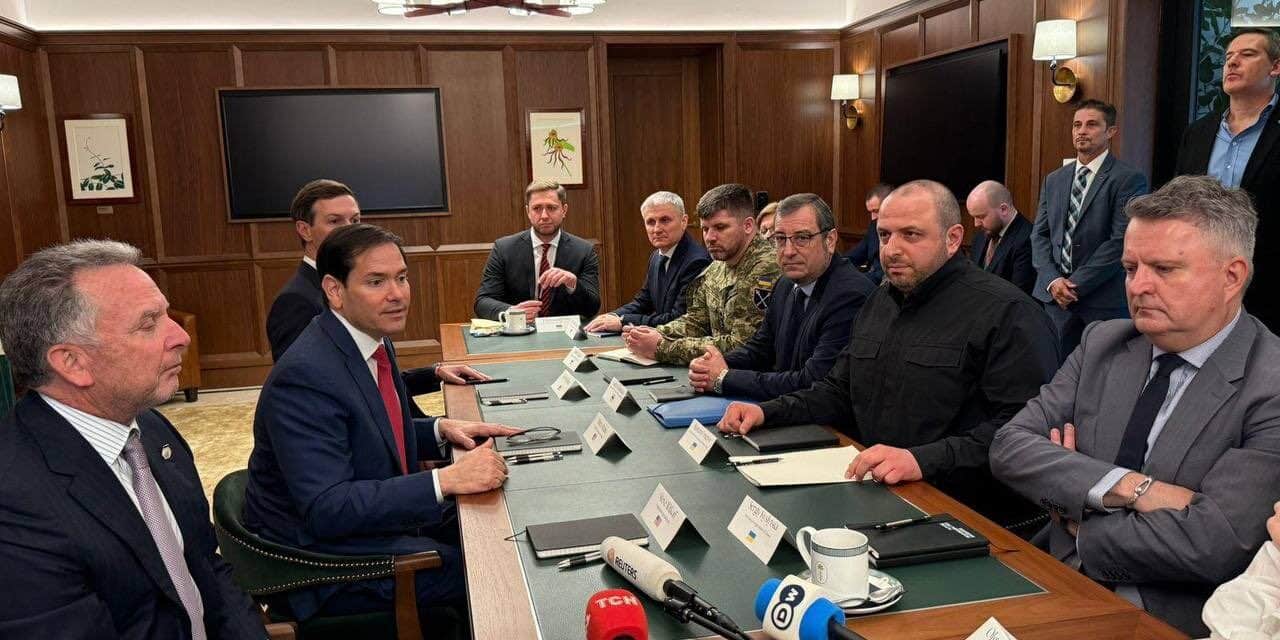
US and Ukraine delegations meet near Miami, Florida, November 30, 2025. The Americans include Secretary of State Marco Rubio (2nd from L), real estate developer Steve Witkoff (1st from L), and Donald Trump’s son-in-law Jared Kushner (3rd from L). Kyiv’s officials are led by Rustem Umerov, head of the National Security and Defense Council (2nd from R).
EA-Times Radio VideoCast: The Battle — Kremlin-Witkoff-Kushner-Vance v. Ukraine-Europe-Rubio
EA on TVP World: Can US-Ukraine Talks Push Back Witkoff-Kushner Collusion With Kremlin?
Sunday’s Coverage: Zelensky Praises US “Constructive Approach”
UPDATE 1852 GMT:
Rustem Umerov, the head of Ukraine’s delegation in negotiations, says, “We told the American side that it is unacceptable for Russia to continue its occupation of our territory and then demand that we grant it legitimacy.”
Umerov, the Secretary of the National Security and Defense Council, told Al Jazeera Arabic, “Giving up our territory means that international law no longer exists and that any party can use force to abolish the sovereignty of another party….We are seeking security for both Europe and Ukraine.”
He noted, “If Russia is prepared for a genuine negotiating format, the upcoming talks will be extremely difficult,” adding that Moscow believes continuation of the invasion is less costly than ending it.
UPDATE 1835 GMT:
The Netherlands has pledged to purchase €250 million of US arms for Ukraine.
The acquisition is under the Prioritized Ukraine Requirements List, established this year for NATO allies to buy advanced US weaponry and transfer it to Kyiv.
Ukraine is set to receive up to $5 billion of arms under the initiative by the end of this year.
Dutch Defense Minister Ruben Brekelmans also announced an agreement, signed with Ukrainian counterpart Denys Shmyhal, for joint drone production in the two countries.
Today, I signed an important agreement with Dutch @DefensieMin Ruben Brekelmans on the joint production of Ukrainian drones.
Production will be split between Ukraine and the Netherlands. The drones will be procured by the Dutch side and delivered to the Ukrainian Defense… pic.twitter.com/jrKQ8wzR06— Denys Shmyhal (@Denys_Shmyhal) December 1, 2025
UPDATE 1612 GMT:
Alongside French counterpart Emmanuel Macron in Paris, Ukraine President Volodymyr Zelensky has told reporters that Kyiv is focused on security guarantees, maintaining its sovereignty and territory.
He stressed that Russia must not get rewards for its aggression on Ukraine, as he hoped for talks with Donald Trump once real estate developer Steve Witkoff returns from Tuesday’s talks in the Kremlin.
Macron reaffirmed France’s “full support” for Ukraine: “At a time when we are talking about peace, Russia continues to kill and destroy.”
He continued the flattery of Trump, commending US efforts to end the war, but “when we talk about peace, everyone has a role to play”.
“Russia must stop the aggression. It has given no signal, no proof to that effect,” he emphasized. Only Ukraine can make decisions about its territory, and security guarantees must not be discussed without Kyiv and its European partners, “the guarantors”.
France’s support holds special significance for Ukraine, and I am grateful to President @EmmanuelMacron and his team for their attention to our people and their willingness to help.
Our engagement today was substantive and important – above all, focused on the steps that bring a… pic.twitter.com/aL3mcUokAO
— Volodymyr Zelenskyy / Володимир Зеленський (@ZelenskyyUa) December 1, 2025
UPDATE 1412 GMT:
Meeting French counterpart Emmanuel Macron for several hours in Paris, Ukraine President Volodymyr Zelensky has posted:
The main focus was on negotiations to end the war and on security guarantees.
Peace must become truly durable. The war must end as soon as possible. Much now depends on the involvement of every leader.
During our several-hour talks, @EmmanuelMacron and I assessed a great many details. The main focus was on negotiations to end the war and on security guarantees. Peace must become truly durable. The war must end as soon as possible. Much now depends on the involvement of every… pic.twitter.com/F2wh2C5dq7
— Volodymyr Zelenskyy / Володимир Зеленський (@ZelenskyyUa) December 1, 2025
Zelensky said he, Macron, and UK Prime Minister Keir Starmer had “an important briefing” with the Ukrainian delegation in talks with the Trump Administration.
Macron and Zelensky also spoke with other European leaders and with Donald Trump’s envoy Steve Witkoff, who is en route to the Kremlin.
UPDATE 1409 GMT:
The toll from Russia’s missile strike on Dnipro has risen to four civilians murdered and 40 wounded, 11 critically.
The ballistic missile hit an industrial area, heavily damaging a car service station and nearby businesses.
The aftermath of the Russian ballistic attack on Dnipro:
Four people killed, 40 more injured.
11 of the injured are in critical condition.
Deepest condolences to all victims of yet another Russian war crime. https://t.co/mYuLKaj3wG pic.twitter.com/RhjPTkvvyi
— Anton Gerashchenko (@Gerashchenko_en) December 1, 2025
UPDATE 1201 GMT:
The European Union has cautioned the Trump Administration against pursuing amnesty for Russian officials over their war crimes in Ukraine.
Commenting on discussions to end Russia’s invasion, EU Commissioner for Justice and Democracy Michael McGrath said:
I don’t think history will judge kindly any effort to wipe the slate clean for Russian crimes in Ukraine.
Were we to do so, to allow for impunity for those crimes, we would be sowing the seeds of the next round of aggression and the next invasion. And I believe that that would be a historic mistake of huge proportions.
McGrath emphasized, “We cannot give up on the rights of the victims of Russian aggression and Russian crimes. Millions of lives have been taken or destroyed, and people forcibly removed, and we have ample evidence.”
UPDATE 1105 GMT:
At least three civilians have been murdered and at least 12 injured by a Russian missile strike on Dnipro in south-central Ukraine.
Russian ballistic strike on Dnipro this morning.
As of now, three people killed, eight more injured. Number likely to grow.
Every day, Russia brings grief and destruction to Ukraine. pic.twitter.com/Yk3PatA9Ar
— Anton Gerashchenko (@Gerashchenko_en) December 1, 2025
UPDATE 1046 GMT:
Russia’s invasion economy continues to contract.
The Russian manufacturing index dropped to 48.3 in November, its sixth consecutive month below the 50-point mark which separates growth from contraction. The streak is the longest since the COVID pandemic, and the monthly decline is the greatest since April 2022.
The decline in activity was caused by a sharp drop in output, a continuing fall in new orders and exports, and supply chain delays. Companies are cutting back on raw materials and components.
The survey found delivery times have increased, even though procurement has decreased. Delays are the worst since February, and manufacturer costs rose at their fastest rate since May.
UPDATE 1038 GMT:
A Ukrainian official summarizes the approach of the US delegation in Florida on Sunday:
The Americans are willing to listen to our arguments….
[But] they constantly say, “Okay, you may be 100% right, but there’s another side, and they’re demanding this and that. As a mediator, we must ensure you reach a peaceful agreement. You can explain your position as logically as you like, but if the other side says ‘no,’ then what will we do?”
UPDATE 1030 GMT:
European Union foreign policy head Kaja Kallas says this week’s discussions “could be decisive for Ukraine”.
Kallas will speak with Ukrainian Foreign Minister Andrii Sybiha and Defense Minister Denys Shmyhal later Monday.
This week could be decisive for Ukraine, Kaja Kallas says
“Yesterday we heard that the talks in the US were difficult but productive. We don’t yet know their results, but I will speak with Ukraine’s defense minister and foreign minister today,” the EU’s top diplomat said.
It is… pic.twitter.com/l55kRQBpuY
— NEXTA (@nexta_tv) December 1, 2025
ORIGINAL ENTRY: Seeking an end to Russia’s 46-month full-scale invasion, US and Ukrainian officials have hailed a “difficult but productive” meeting in Florida.
In more than four hours of discussions, the delegations worked through an European counter-proposal, tabled last week in Geneva in response to a 28-point ultimatum to Ukraine. The demands, presented as Donald Trump’s “peace plan”, were developed by Vladimir Putin’s senior economic advisor Kirill Dmitriev with real estate developer Steve Witkoff and Trump’s son-in-law Jared Kushner.
US Secretary of State Marco Rubio, who has led the pushback against the Trump-Kremlin ultimatum, said yesterday’s discussions were “very productive”. The meetings focused on Ukraine’s “long-term prosperity” as well as a halt to Moscow’s attacks.
I thought we started laying the groundwork in Geneva. I think we continued that work in our communications throughout the week. I think we’ve built on that today, but there’s more work to be done.
This is delicate, it’s complicated, there are a lot of moving parts, and, obviously, there’s another party involved here.
U.S. Secretary of State Marco Rubio said that Ukraine needs long-term security guarantees
He added that the talks in Florida were productive, but more work is still required. According to him, the goal of the meeting was not just to achieve peace at any cost, but to preserve… pic.twitter.com/vv8LW4XYAf
— NEXTA (@nexta_tv) December 1, 2025
Both Witkoff and Kushner were in the US delegation, but neither gave public statements to the press.
Rustem Umerov, the Secretary of Ukraine’s National Security and Defense Council, said the talks were “productive and successful”: “We discussed all the matters that are important for Ukraine. And the U.S. was super-supportive.”
Other officials offered mixed assessments. One told CNN that the conversations were “tough but very constructive” on some of “the most sensitive issues”.
“So far so good,” they summarized.
Another, close to the Ukrainian delegation, was more guarded in remarks to AFP: “Not easy. The search for formulations and solutions continues. Everyone is interested in a practical result so that there is a subject for further negotiations between the US and Russia.”
No details were given of specific provisions.
Ukraine President Volodymyr Zelensky posted late Sunday night, expressing gratitude to the US delegation and to Trump “for the time that is being invested so intensively in defining the steps to end the war”.
It is important that the talks have a constructive dynamic and that all issues were discussed openly and with a clear focus on ensuring Ukraine’s sovereignty and national interests.
Trump Envoy Witkoff in Moscow on Monday
Attention turns to the Kremlin on Monday as Trump’s envoy Witkoff and Kushner visit. In previous encounters with Vladimir Putin, Witkoff has not been accompanied by another US official and has relied on a translator from Russia’s intelligence services.
Meanwhile, Zelensky will confer with French President Emmanuel Macron in Paris.
Witkoff, Kushner, and Dmitriev agreed on Russia seizing more territory, notably the 22% of the Donetsk region still held by Ukrainian forces in the east of the country. The rest of Ukraine would be kept in permanent weakness through a ban on NATO membership and foreign forces in the country, strict limits on Kyiv’s troop levels, and restrictions on Western military assistance.
Sanctions will be lifted on Russia in stages, and Moscow will be readmitted to the G8 group of nations. The US and Russia will pursue joint economic projects, and the Trump Administration will also get 50% of profits from Ukraine’s recovery fund.
The European counter-proposal begins with a ceasefire on the current frontlines. There is no ban on Ukraine on NATO, although there is no consensus for Kyiv’s membership. Troop levels are raised to 800,000 in peacetimes, and Western military assistance is part of security guarantees.
Russia will have to show compliance with the agreement for the removal of sanctions and G8 membership. The provision for US profits from the recovery fund, which is backed by $1 billion in frozen Russian assets, has been removed.
US Side: No Automatic Ban on Ukraine in NATO
An unnamed US official — possibly Rubio — briefed CNN that Sunday’s meeting discussed the ban on Ukraine in NATO. This would have to be agreed by NATO members, and a final decision would ultimately be made by Zelensky.
However, other arrangements would not necessarily require Kyiv’s consent.
Ukraine will not be pushed to officially, in the legal sense, reject this aspiration….
But if the United States has something to agree upon with Russia bilaterally, or if Russia wants to receive some assurances from NATO multilaterally, then this is not engaging Ukraine in the decision-making process.
The official also pushed back the Trump-Kremlin provision for Russia to seize the rest of the Donetsk region.
The idea to give up the control to Russians, where it would significantly weaken Ukraine’s defense and make further potential aggression more likely to happen and significantly decrease Ukraine’s capability, this is out of the scope.
But that doesn’t mean that there are no potential ways of preserving the constitutional provisions and keeping Ukraine’s security.