
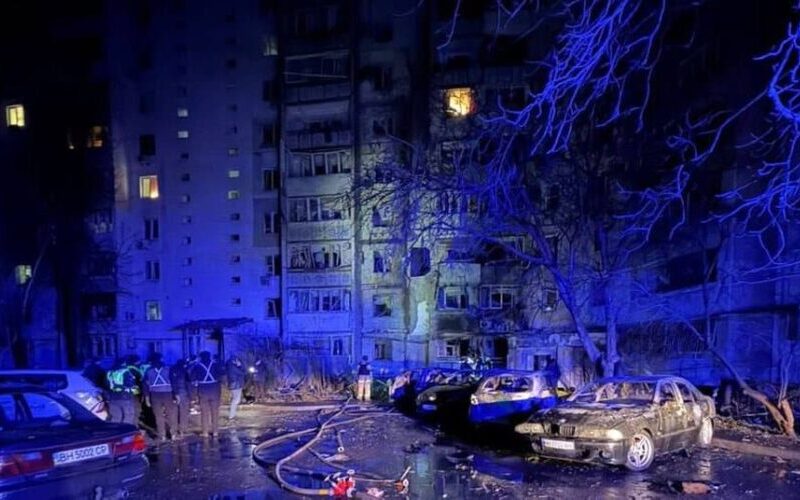
Residential building damaged in a Russian drone strike on Odesa, Ukraine, December 31, 2025
EA on TVP World: Ukraine, Europe, and Trump — The Showdown Over Security Guarantees
EA on RTE: What’s Next for Ukraine After Zelensky-Trump Meeting in Florida
UPDATE 1517 GMT:
Russia is using intermediary companies to import aviation tires made by the French firm Michelin despite sanctions, according to customs records.
Data indicated that shipments of Michelins worth $28 million were received in 2023 despite the company halting all exports after Russia’s full-scale invasion of Ukraine.
Latest information indicates sales have continued, although in reduced volumes, evading Michelin’s attempts to cut off the trade by adapting their systems to monitor the diversion of their products.
Between October 2024 and March 2025, Russia received 2,687 Michelin tires worth more than $7 million. Deliveries were sent by companies based in Turkey, Spain, Saudi Arabia, and India. One firm was named as General Trade Solutions (UK), but there is no firm registered with the UK’s Companies House with that name.
UPDATE 1041 GMT:
Romania has joined the initiative for NATO members to buy US weapons and transfer them to Ukraine, committing €50 million.
The Foreign Ministry said the contribution supports peace by strengthening Ukraine’s military capabilities.
Romania Joins the PURL Mechanism to Support Ukraine’s Defense.
The Government of Romania has adopted a decision to join the states contributing to the United States’ proposal regarding the “Priority Acquisition List for Ukraine’s Defense” (PURL), with a contribution of EUR 50…
— Toiu Oana (@oana_toiu) December 30, 2025
Croatia will contribute €15 million euros, confirmed the country’s foreign ministry.
There are now 24 countries in the PURL program.
UPDATE 1030 GMT:
At least 6 civilians were murdered and at least 23 injured by Russian attacks across Ukraine over the past day.
Air defenses downed 101 of 127 drones launched by Russia overnight, but 20 struck 11 locations.
In the Donetsk region in the east, three civilians were killed and four injured.
In the neighboring Kharkiv region, shelling killed a 68-year-old man and damaged several houses.
One man was murdered and three people injured amid at least 697 shellings of the Zaporizhzhia region in southern Ukraine.
In the Sumy region in the northeast, Russian shelling killed one person.
In the Odesa region (see Original Entry), six civilians were injured, including two children and a 7-month-old infant. One adult is in serious condition.
Four apartment buildings and at least 14 cars were damaged. Power was cut to more than 170,000 people as Russia targeted two facilities of Ukraine’s largest private energy company DTEK.
Casulaties were also reported in the Kyiv, Chernihiv, Kherson, and Dnipropetrosk regions.
UPDATE 0741 GMT:
Documenting the Trump Administration’s chaotic approach to Russia’s invasion of Ukraine, the New York Times details how Vice President J.D. Vance led a faction supporting the Kremlin, trying to halt US support of Kyiv’s resistance.
Vance “seeded like-minded officials at the Pentagon and elsewhere in the administration” and sidelined Trump’s envoy to Ukraine and Russia, Keith Kellogg, who had developed a plan for negotiations while maintaining US support for Ukraine’s defense.
The Vice President said Kellogg could talk to the Ukrainians and Europeans, but he instructed aides to “keep him away from the Russians.”
That opened the way for real estate developer Steve Witkoff to collude with the Kremlin, as he was courted by Vladimir Putin’s top financial advisor Kirill Dmitriev.
Vance pursued his mission in the Pentagon through the new Undersecretary of Defense Elbridge Colby, who said of US assistance to Ukraine, “We would have been better served to put a lot more of that money to use in the Pacific.” Colby soon produced a review which recommended the halt of US weapons and munitions to Kyiv.
At a White House meeting to discuss Kellogg’s plan to end the Russian invasion, Trump declared that he did not like Ukraine President Volodymyr Zelensky. He then shot down Kellogg, “Russia is mine, not yours.” When Defense Secretary Pete Hegseth mentioned Colby’s recommendation not to provide the Biden Administration’s unspent $3.8 billion in military aid to Kyiv, Trump agreed, “We’re not going to do that right now.”
Trump told Hegseth, “You just go ahead and you don’t need me to make decisions.” So later that day, the Defense Secretary ordered a halt to all assistance, including military aid at US base in Germany awaiting transfer to Ukraine.
Amid backlash from agency officials, including in the Pentagon and State Department, and allies in Congress, the ban was lifted six days later. But Hegseth despised the US Supreme Allied Commander in Europe, Gen. Christopher Cavoli, for telling him, “If we stop doing this, it’s going to veer to the wrong side.”
Rejecting the appeal of Ukrainian counterpart Rustem Umerov — “You can trust me; you can trust us” — Hegseth told Kyiv and its European counterparts that Ukraine must give up not only its aspiration for NATO membership but also any return to pre-2014 borders or any US involvement in a peacekeeping force.
Three days later, on February 14 at the Munich Security Conference, Vance told the audience that Ukraine and Europe could no longer count on an American alliance.
And two weeks after that, trying to prevent any resumption of US support, he ambushed Zelensky in the White House, prompting Trump’s angry lecture of the President and the eviction of the Ukrainian delegation.
After the Ukrainians left, Vance, Hegseth, and their staffs cheered the humiliation of Zelensky and his officials.
UPDATE 0658 GMT:
Ukraine President Volodymyr Zelensky has called out India, the UAE, and other countries for their amplication of Russia’s unsupported claim that the Ukrainians attacked a residence of Vladimir Putin.
The Kremlin has produced no evidence for the claim, seen by analysts as an attempt to derail negotiations for an end to its invasion of Ukraine — and by Zelensky and European officials as a pretext to attack government buildings in Kyiv.
“It is confusing and unpleasant that some countries, like India, the UAE, and a few others, condemned what they claim were our drone strikes on Putin’s residence — which didn’t even happen,” Zelensky told Ukrainian journalists. “Where is their condemnation of the fact that our children are being bombed and people are being killed all this time? I don’t hear India, frankly, nor the United Arab Emirates.”
Indian Prime Minister Narendra Modi posted on Tuesday:
Deeply concerned by reports of the targeting of the residence of the President of the Russian Federation. Ongoing diplomatic efforts offer the most viable path toward ending hostilities and achieving peace. We urge all concerned to remain focused on these efforts and to avoid any…
— Narendra Modi (@narendramodi) December 30, 2025
The UAE Foreign Ministry said on Monday that it “strongly condemns” the “deplorable attack” and “the threat it poses to security and stability”.
UPDATE 0651 GMT:
Ukraine has reportedly struck the Tuapse Oil Refinery in Krasnodar Krai in southwest Russia.
Local authorities said a dock was damaged alongside equipment at the refinery. A fire was set across 300 square meters.
Tuapse is one of Russia’s key Black Sea outlets for oil products. The port and refinery have been hit repeatedly by Ukrainian drone attacks.
ORIGINAL ENTRY: Russia launched more waves of missile and drone strikes on the Odesa region in southern Ukraine overnight, targeting civilians, ports, and energy infrastructure.
The latest assault around 12:20 a.m. struck four residential buildings, again leaving parts of the city without heat, electricity, or water. Five civilians were injured, including two children and a 7-month-old infant.
Serhii Lysak, the head of Odesa City Military Administration, summarized, “Another proof that Russia is targeting civilians.”
Early Tuesday, the Russians launched waves of attack drones on the Black Sea ports of Pivdennyi and Chornomorsk. Two Panama-flagged civilian vessels, Emmakris III and Captain Karam, and oil storage tanks were struck.
The Ukraine Navy said the attacks “threaten the lives of civilians and undermine global food security. Targeted strikes on civilian objects are a deliberate war crime.”
Ukraine Deputy Prime Minister Oleksiy Kuleba said both ports continue to operate.