
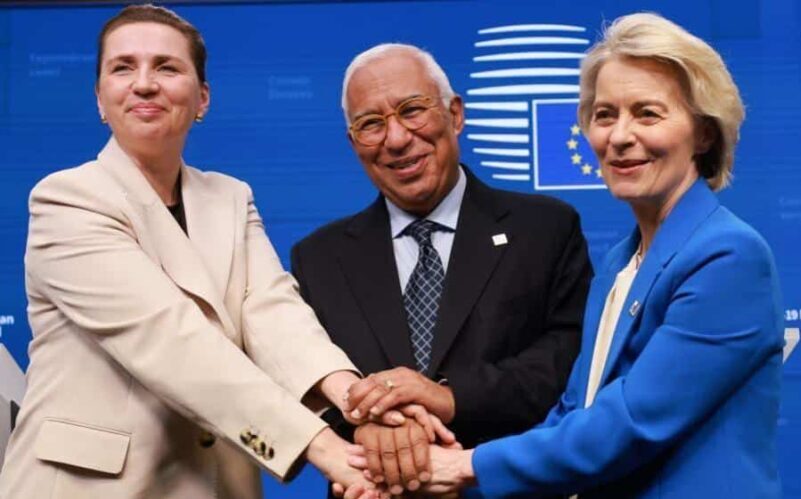
L to R: Danish Prime Minister Mette Frederiksen, European Council President António Costa, and European Commission President Ursula von der Leyen announce Ukraine loan deal, Brussels, Belgium, December 19, 2025
EA-Times Radio VideoCast: Trump’s Epstein Problem; Ukraine’s European Lifeline
EA-War and Politics 24 VideoCast: “Ukraine Still Stands”
Thursday’s Coverage: EU Considers “Reparations Loan” to Kyiv from Frozen Russian Assets
UPDATE 1656 GMT:
Ukraine Finance Minister Serhiy Marchenko has reminded partners that the European Union’s €90bn loan does not fully cover Kyiv’s financial needs through 2027.
Marchenko said, “The reparations loan [from frozen Russian assets] is a systemic, long-term solution. It will ensure sustainable defense capabilities and protect Europe from future conflicts.”
UPDATE 1520 GMT:
Welcoming Ukraine President Volodymyr Zelensky, Polish Prime Minister Donald Tusk has said of the European Union’s agreement on a €90 billion loan to Kyiv: “Always something could be better, more efficient, but I am really satisfied at least we delivered what we promised.”
Zelensky said Europe “showed leadership” as Russia hoped to “cancel” EU funding for Ukraine.
Tusk told Zelensky, “Your fight is our common fight”. He added, “You are a hero not only in Ukraine, but here in Poland [we] also treat you as a hero.”
Zelensky responded, “The scariest thing for Russia is if we are together. Because they definitely cannot defeat the two of us.”
UPDATE 1452 GMT:
Australia has delivered a dozen US-made Abrams tanks to Ukraine.
The tanks are the last group of 49 which Canberra has sent to Kyiv since July. They were shipped to Poland by cargo ship in October and later transported by rail to Ukraine.
UPDATE 1444 GMT:
At least four civilians have been murdered and 29 injured by Russian attacks across Ukraine over the past day.
Air defenses downed 108 of 160 drones, but 47 struck 23 locations.
In the Kherson region in the south, two civilians were killed and 12 injured.
In the Odesa region, a woman was murdered and her three children wounded by a Russian drone attack on their car.
In the Kharkiv region in the northeast, a 22-year-old man was slain and seven people injured in attacks on 12 settlements.
Casualties were also reported in the Zaporizhzhia, Donetsk, and Dnipropetrovsk regions.
Residents in five Ukrainian regions are without power.
More than 73,000 consumers in Odesa and more than 26,000 in Dnipropetrovsk have been cut off.
The Sumy, Zaporizhzhia, and Donetsk regions are also affected.
“Wherever the safety situation allows, emergency repair work is already underway. At the remaining facilities, energy workers are awaiting permission from the military,” reported Ukraine’s State energy company Ukrenergo.
Measures to restrict energy consumption have been implemented in most Ukrainian regions.
UPDATE 1349 GMT:
Ukrainian drones have attacked a tanker in Russia’s “shadow fleet” off the coast of Libya, 1,250 miles from its border.
The strike on the Qendil reportedly caused “critical damage” so the ship cannot be used for its intended purpose”, said an official in Ukraine’s State security service SBU.
Ukraine has damaged a series of Russian tankers this month. The vessels are used to evade international sanctions on Moscow’s maritime oil exports.
The Ukrainian official said Friday’s attack was a “new, unprecedented special operation” without giving details. The cargo ship was empty at the time and the operation caused no environmental threat.
“The enemy must understand that Ukraine will not stop, and will strike them anywhere in the world, wherever they may be,” the official emphasized.
Another Ukrainian official explained:
This tanker was used to circumvent sanctions and earn money that was used for the war against Ukraine. Therefore, from the point of view of international law and the laws and customs of war, this is an absolutely legitimate target for the SBU. The enemy must understand that Ukraine will not stop and will beat him anywhere in the world, wherever he is.
UPDATE 1233 GMT:
The US Treasury has lifted sanctions on several international companies who had been blacklisted for supplying sanctioned equipment for Russia’s military-industrial complex.
The Treasury gave no reason for the decisions.
Among those removed is Cyprus-based Veles International and its owner Dmytro Bugayenko, sanctioned in 2023 for “activity in the financial services sector of the economy of the Russian Federation” as a “Moscow-based investment and management company that works with wealthy Russian private individuals”.
The Moscow-based legal entities of the company are still sanctioned.
Also removed from the list are Finland’s Hi-Tech Koneisto, which supplied sanctioned entities in Russia with opto-electronic goods and laboratory equipment; Dubai-based 365 Days Freight Services; Turkey’s Etais; and the Turkish-based CPS Proses Kontrol Urunleri Sanayi Ve Ticaret Anonim Sirketi, which supplied German and American machine tools to a sanctioned Russian defense contractor.
UPDATE 1214 GMT:
Visiting Polish President Karol Nawrocki in Warsaw, Volodymyr Zelensky has emphasized the importance of Poland and Ukraine as guarantors of freedom in central and eastern Europe.
He hailed “positive” talks about efforts to end Russia’s invasion.
Welcoming the EU deal on funding Ukraine, Zelensky said it is critical that Russian assets in Europe remain frozen.
Nawrocki said Zelensky’s visit is “bad news for Moscow”, as it shows unity on security and defense between Warsaw, Kyiv, and their partners in the region.
Russia is seeking to “disrupt the international order” and destabilize political systems, with “hybrid” attacks taking place on an “almost daily basis”, Nawrocki explained.
Poland supports strict sanctions against Russia, he reiterated.
UPDATE 1158 GMT:
The UN General Assembly has adopted a resolution condemning Russia’s human rights violations in occupied areas of Ukraine.
The vote was 79-16 with 73 abstentions. Significantly, having refused to support criticism of Russia’s invasion in UN resolutions earlier this year, the US voted Yes.
The resolution condemned Russia’s war of aggression, reaffirmed Ukraine’s sovereignty and territorial integrity, and stresses the non-recognition of Russian attempts to change the status of Ukrainian territories.
It expressed serious concern about the militarization of the occupied territories; the forced mobilization ofresidents into the Russian Armed Forces; the persecution of journalists, human rights defenders, and civil society representatives; and the destruction of cultural heritage.
Ukraine Foreign Minister Andrii Sybiha responded:
I welcome the adoption of the updated UNGA resolution on the human rights situation in Russia-occupied territories of Ukraine, including Crimea and Sevastopol.
Ukraine has initiated this resolution annually since 2016. The document strongly condemns Russia’s aggression,… pic.twitter.com/7TeBBKIDCj
— Andrii Sybiha (@andrii_sybiha) December 18, 2025
UPDATE 1107 GMT:
Belgian Prime Minister Bart de Wever has hailed the European Union’s budget loan, rather than a “reparations loan” based on frozen Russian assets, to Ukraine.
Supporting Ukraine is not charity, it is the most important investment we can make in our own security….There was never any debate about whether we would help; the only real question was how we should help….
If Europe had walked away today with a without an agreement, we would not only have failed Ukraine, we would have failed ourselves.
Having blocked the reparations loan, with Belgium holding 88% of the Russian assets, he said the loan from the EU budget was “a stable, legally robust and financially credible” solution which “protected Europe’s economic and financial credibility” and safeguarded “trust in European institutions, markets and the euro”.
UPDATE 0743 GMT:
Donald Trump has signed a $900 billion US defense spending bill which includes $800 million in military assistance for Ukraine.
The House passed the bill in a 312-112 vote, and the Senate by 77-20 on Wednesday.
Kyiv will receive $400 million annually in fiscal years 2026 and 2027 through the Ukraine Security Assistance Initiative (USAI), financing weapons contracts with U.S defense companies.
The bill requires the Defense Department to notify Congress within 48 hours of any decision to restrict intelligence sharing with Ukraine.
The Pentagon cannot reduce the number of US troops “permanently stationed in or deployed” to Europe below 76,000 for longer than 45 days.
ORIGINAL ENTRY: The European Union has agreed a €90 billion ($105.5 billion) loan to cover 2/3rds of Ukraine’s financial needs through 2027.
The EU made the pledge after failing to reach consensus on a “reparations loan” drawn from €210 billion ($246 billion) in frozen Russian assets, mainly because of objections by Belgium.
European Council President António Costa told reporters early Friday, “We committed and we delivered.” He noted, that despite the failure to complete the reparation loan, “The union reserves its right to make use of the immobilised assets to repay this loan.”
The deal for the €90 billion loan was sealed by Hungary’s decision not to use its veto. Hungary — led by long-time Russian ally Viktor Orbán — Slovakia, and Czechia will make no financial contribution to the loan.
Back in business! pic.twitter.com/3sMffH7XYC
— Orbán Viktor (@PM_ViktorOrban) December 18, 2025
German Chancellor Friedrich Merz said the agreement was “a decisive message because Putin will only make concessions once he realises his war will not pay off”. He echoed Costa:
If Russia does not pay reparations we will – in full accordance with international law – make use of Russian immobilised assets for paying back the loan.
Danish Prime Minister Mette Frederiksen noted that it was “quite something” to get the agreement. She cautioned:
There are a lot of people outside the European Union and unfortunately also inside the European Union who tries to divide us. It is getting more and more difficult and I think this will continue.
Zelensky: “This Truly Strengthens Our Resilience”
Earlier Belgium, which holds 88% of Russian funds in the EU, had demanded unlimited budget guarantees from other member states if Russia won a successful claim for damages.
Belgian Prime Minister Bart De Wever said, despite intense lobbying by Ukraine President Volodymyr Zelensky and other European leaders:
There were so many questions that I said, “I told you so, I told you so.” There are a lot of loose ends. And if you start pulling at the loose ends in the strings, the thing collapses.
Russia had pressed Belgium to hold out against an agreement. The Russian Central Bank is suing Euroclear, the Belgian company which holds frozen assets, for $230 billion. Euroclear executives and Belgian Government officials are facing a campaign of intimidation orchestrated by Russian intelligence.
The Trump Administration reportedly added to the pressure by demanding “the money back” if the EU used the assets. It lobbied countries such as Italy to block consent.
But any disappointment was swept away early Friday by the confirmation of the EU budget loan. Ukraine President Zelensky posted:
I am grateful to all leaders of the European Union for the European Council’s decision on €90 billion in financial support for Ukraine in 2026–2027. This is significant support that truly strengthens our resilience. It is important that Russian assets remain immobilized and that…
— Volodymyr Zelenskyy / Володимир Зеленський (@ZelenskyyUa) December 19, 2025