
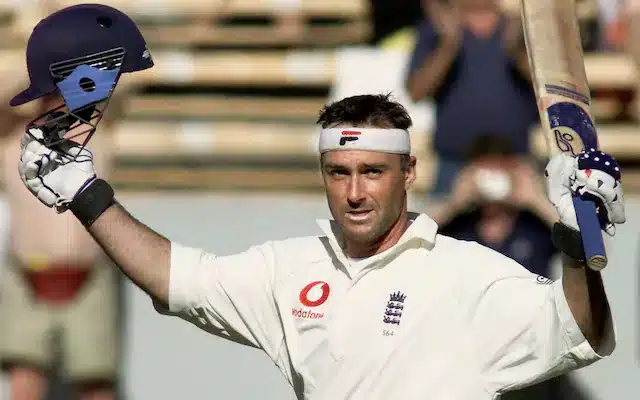
England cricket star Graham Thorpe
I grew up in the 1990s as an England cricket fan. It was not an easy obsession, being glued to every match, every collapse, every follow-on. Results were often grim as the Test and series defeats piled up. The Ashes against Australia was a cruel, endless ritual. The West Indies smacked English deliveries to and beyond the boundaries, while their fast bowlers toppled England’s wickets. The reverse swing of Pakistan’s Waqar and Wasim charge was too much for any resistance.
But in that era of defeats, three English batters were my heroes: Michael Atherton, Graham Thorpe, and Robin Smith. On the TV screen or at the Edgbaston Cricket Ground, they taught me that grit, resilience, and fearless defiance mattered more than the scoreboard.
Atherton has and will always be my childhood hero — while friends saw Waqar, Wasim, Sachin or Lara as role models, for me it was the dry, stoic, sturdy England captain who now is a cricketing broadcaster and icon. His 185 not out at Centurion Park in 1995 against South Africa wasn’t just a scorecard entry: it was a masterclass in mental and physical endurance. Thirteen hours at the crease against Allan Donald and Shaun Pollock demanded more than technique; it required an iron will. Every ball was a test of patience, every spell a battle against fatigue and fear.
Atherton absorbed pressure like a sponge, refusing rash strokes, refusing to surrender. In an era when England often folded, his vigil saved the game and symbolised cricket’s unique demand: resilience over flamboyance. It proved that in this sport, victory is not always about aggression. Sometimes it is about surviving, thinking, and enduring longer than anyone else.
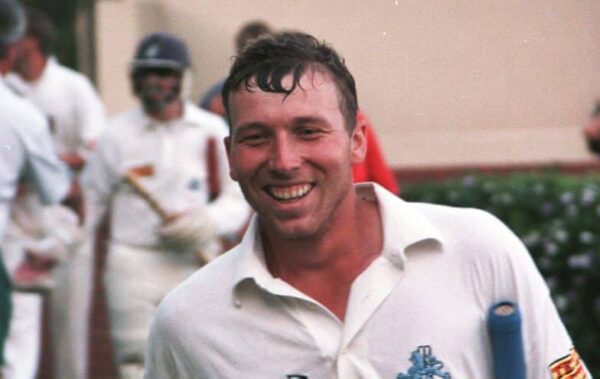
Michael Atherton after he saved the second Test v. South Africa in Johannesburg in 1995
Graham Thorpe and Robin Smith, cut from the same gritty 90s cloth, were cricketing mavericks. Thorpe was calm resilience, the man who rebuilt fragile innings without fuss. His 123 in Christchurch, New Zealand in 2002, rescuing England from 106–5, and his debut hundred at Trent Bridge in 1993 demonstrated his composure, graft, and the ability to steady chaos.
Smith, “The Judge”, was pure defiance. He faced the world’s quickest bowlers with no face guard and a swagger that made intimidation pointless. His 148 against the West Indies fast bowlers — Marshall, Ambrose, Walsh, Patterson all charging in — at Lord’s in 1991, and his 167 against Australia in 1993 proved his fearlessness and outrageous skill with the trademark square cut that turned pace into runs.
As a kid, I held a battered tennis ball bat in my back garden and pretended that Robin Smith’s fearlessness and impervious self-belief were mine.
But Thorpe took his own life this February. Smith died last week, having acknowledged his mental health challenges and alcoholism after he stopped paying cricket in 2003.
When these men showed their vulnerability, it felt like losing a piece of my childhood. Not because they failed. Rather because they proved that the ideals we conferred on them — invincibility, toughness, and silence — were always a myth.
Cricket and The Weight of “Being a Man”
Cricket’s tempo — tests of up to five days juxtaposed with the rapidity or spin of each delivery — demands relentless concentration and psychological endurance. Unlike sports that end in bursts of action, a single lapse can undo hours, even days, of competition.
The pressure is magnified by the isolation of long tours away from family, endless scrutiny, and the expectation of stoic toughness. Players are cast as warriors, impervious to fear or fatigue.
For decades, the vulnerability of icons like Graham Thorpe was
hidden because English culture equated silence with strength. There were rigid expectations about masculinity: Real men don’t complain, don’t cry, don’t need help.
I remember at the age of 15, batting for Walsall Star CC, I withered when I was hit on the arm by a fast delivery. Senior players told me, “It’s just not cricket showing any pain. It is a sign of weakness.”
So for many cricketers, suffering is invisible because weakness is unthinkable. Outside the stadium, the struggle is even starker. The Lost Boys report depicts how boys and young men in Britain are facing a mounting crisis of poor health, isolation, weak social networks, and an increasing risk of suicide.
Statistics are blunt and unforgiving. The male suicide rate in England and Wales in 2023 reached 17.4 per 100,000. It was the highest level since 1999, and even higher for those aged 50 to 54. The comparative rate for females was 5.7 per 100,000.
In 2019, I wrote about a study which found that the majority of
Britons feel they do not have enough friends. Two in three admitted that they regularly feel lonely. In another survey, 18% of men said they had no close friend, and 32% said they had no one which they considered as a best friend. And this was before COVID-19.
See also Facing Up to the Age of Loneliness
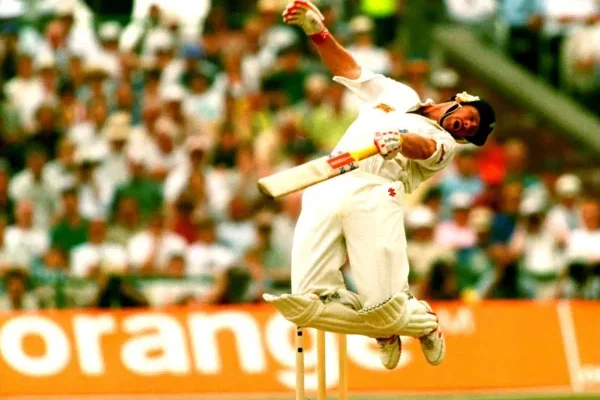
Robin Smith avoids a bouncer
Failing the Vulnerable
The current England batting coach and former opening batsman Marcus Trescothick has spoken openly about depression and panic attacks. Jonathan Trott withdrew from the 2013–14 Ashes series under immense psychological pressure. In his final days, Robin Smith admitted that he wished he had reached out sooner.
But beyond cricket in 2025, many men are falling through the cracks. We have not built a world that supports them because systems, institutions and cultural expectations still treat vulnerability as failure.
Whether as fans, as policymakers, as friends, as human beings, we owe them more. We need to set aside applause and nostalgia and dismantle the cruel, outdated idea that “real men don’t talk” The truth is that real men struggle.
Public awareness is growing, but it must translate into policy. The government’s call for evidence on a men’s health strategy is a start, but voices from all walks of life. Mental health cannot remain an afterthought in sport or society.
Whether on the pitch, at home, at work, in our places of worship, or in our daily routines, we need to change the culture. Cheer the sixes, celebrate the centuries, but also learn to ask: “Are you okay?”
A Fan’s Plea
As a kid in the 1990s, I lifted a bat and believed that hardness defined strength. I admired those men not just for their runs, but for the image they projected: stoic, fearless, upright. I never imagined that inside their heads there might be fear, loneliness, and despair.
Over the years I’ve realized: that image was a construction. It helped sell tickets, made sponsors happy, kept young fans believing. Maybe it inspired grit. But it also hid the faultlines.
As I watch a new generation both in sport and in society, I see how fragile our myths are. I see how much pressure modern life places on men. I see the silent suffering, the loneliness, and the shame.
We urgently need to reimagine strength. Because real strength isn’t silence. Real strength isn’t stoicism. Real strength, the kind that saves lives begins, when someone admits they are not okay.
Let’s build a world where men don’t have to wait for retirement, breakdown, or tragedy to find help. Let’s build a world where asking for help is not a failure but a mark of humanity.

A very well written article about a subject infrequently discussed. Thank you for challenging the classic stereotype, and shedding light onto this dark area. May your message reach far and wide.
Excellent and important article