
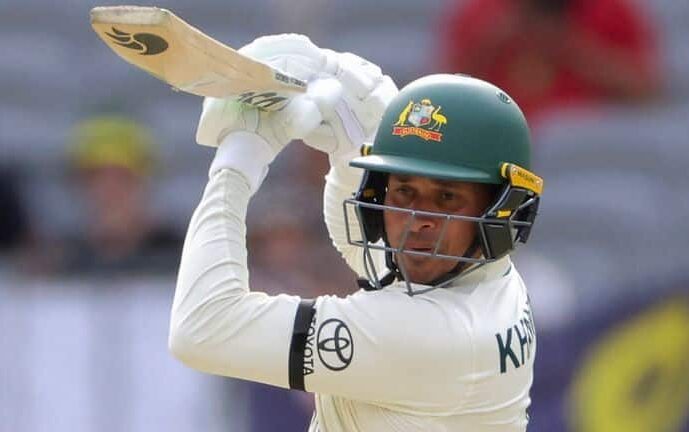
Australia cricketer Usman Khawaja wearing a black armband for Gaza in a Test match against Pakistan in 2023 (Sky)
A Risky Wicket: Cricket, Masculinity, and Mental Health
Cricket will record Usman Khawaja’s career in the language it understands best. The 6229 runs in 88 Test matches and more than 15,000 runs in first-class cricket. The 16 Test centuries and 43 first-class centuries.
It will honor his calm leadership at the top of Australia’s batting order, the man trusted to blunt new balls in England, India, Pakistan and at home. He will be remembered for his late-career renaissance and the quiet authority of a senior professional who di not need theatrics to command respect.
But those who truly know Usman Khawaja, as he announces his retirement from all forms of international cricket, will recognize that his significance was never confined just to runs. His legacy is about values, decency, a moral compass, and the right choice, even when it came at a personal cost. This is why his retirement does not feel like an ending, but the beginning of another chapter.
Khawaja earned his place in cricket’s history the hardest way, fighting the system. He was dropped, recalled, dropped again, and questioned endlessly. Each time, he came back mentally durable and relentlessly professional. Lovers of crickets know how unforgiving Test cricket is, particularly for openers. They know how rare it is to return in your mid-30s and look better than ever.
So when Khawaja spoke, it wasn’t from the margins. He spoke as someone who had paid his dues, carried the Aussie green cap with honour, and done the hard yards.
And that voice is not just about sport but also about politics.
Politics and Sport Don’t Mix — Except When They Do
Cricket has always pretended to be apolitical while being deeply political, whether the recurrent India v. Pakistan narrative or the boycott of South African cricket during apartheid. However, when a cricketer raises their voice about Muslim lives, Palestinian suffering, or racialized double standards, the call is issued: “Keep politics out of sport.”
Khawaja highlighted that hypocrisy in late 2023. As Israel was devastating Gaza, he wrote “Freedom is a human right” and “All lives are equal” on his shoes in the colors of the Palestinian flag. He said he acted because silence no longer felt acceptable.
Khawaja’s stance on Gaza was not new or performative. It was measured, humane, and grounded in the same values he expressed throughout his career. He reiterated his concern about civilian suffering and the killing of children with a call for humanity.
That statement from a moral compass should have been received with approval or at least a restraint from comment. Instead, there was a seismic reaction with a warning from cricket authorities, institutional unease, and the familiar demands that sport remain “neutral”. Khawaja’s stance was misrepresented with accusations of anti-semitism. There were calls for him to be censured or even dropped.
The response told its own story: beyond the cricket pitch, some lives are less valuable than others.
Bondi, Grief, and the Limits of Belonging
After the killing of 15 people on Bondi Beach by an Islamic State attack during a Hanukkah celebration, Khawaja responded as any decent human being should: with empathy, grief, and solidarity. He publicly expressed sorrow for the Jewish community, condemned anti -semitism, and prayed for those affected.
Khawaja’s wife and young daughters were subjected to a torrent of Islamophobic abuse online, some of it explicitly violent. His children were targeted for being Muslim. The cricketer continued to state calmly that anti-semitism, Islamophobia and racism must all be opposed.
In his retirement speech at the Sydney Cricket Ground, Khawaja spoke directly to those who grow up loving cricket but sense they do not fully belong: “I’m a proud Muslim, coloured boy from Pakistan who was told he would never play for Australia. Look at me now.”
He had politely called out cricket, which for all its claims of meritocracy, has long operated with hierarchies about who fits and who must prove themselves twice over.
Much of the Australian cricketing establishment offered him little or no support. Social media was flooded with familiar dismissals: the claims that racism is exaggerated and that sport is“color-blind”.
Khawaja’s call took on a history of cricket with monkey chants directed at Black players in England, testimony about casual racism at the Yorkshire Cricket Club, and repeated abuse faced by South Asian players at club and county level. Former cricketer and BBC commentator Isa Guha has spoken about the issues of representation and identity. Sunil Gavaskar, the Indian batting legend, has reflected on the emotional toll of being a player from the Asian sub-continent in a Western system.
Usman Khawaja has not shied away from that challenge. Yet, as he moves from retirement into the next phase of his contribution, he has given a powerful hope. Hurdles can be overcome. You can reach the summit of the game, and the summit of a decent life, without erasing who you are or where you come from.
