
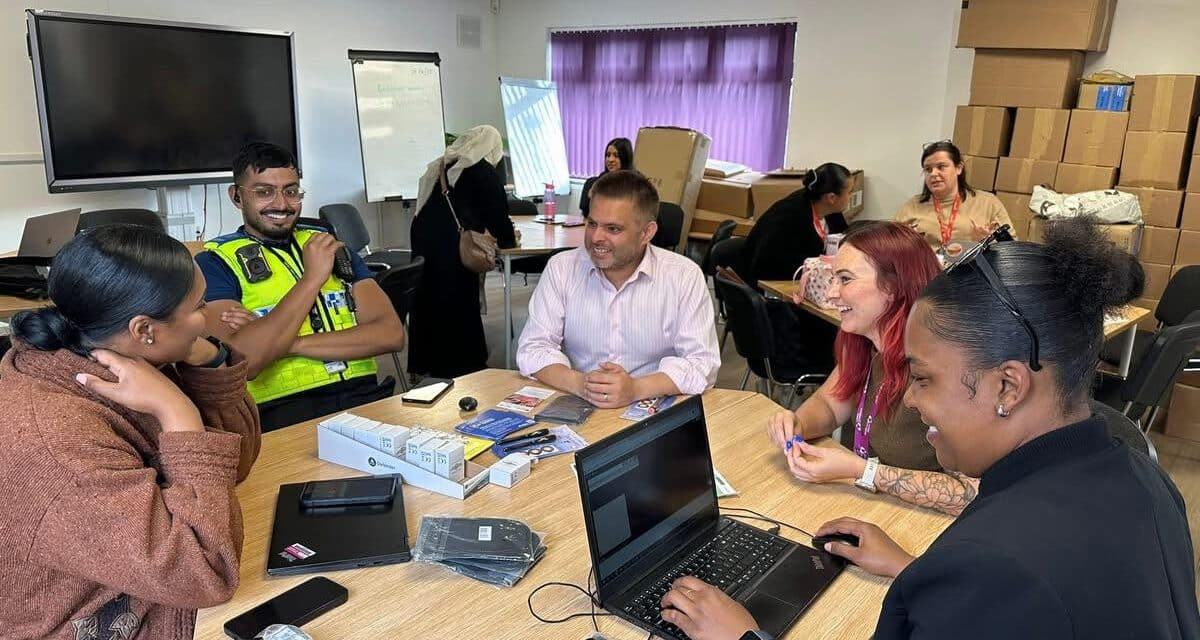
Waseem Zaffar (C) at a community center in Birmingham, UK
Birmingham Isn’t Broken — Hard-Right Britain Is
My city of Birmingham, in the United Kingdom, is still coming to terms with the loss of Waseem Zaffar.
Waseem, 44, a city councilor, died suddenly while visiting Pakistan on January 30. For his wife and three young sons, the grief is immeasurable. For his Lozells district and for all of Birmingham, this is not just the permanent absence of a councillor. It is the departure of someone who believed wholeheartedly in the city and its people, a true leader with a vision and purpose.
Waseem was proud of putting community before everything else. He showed quietly but confidently that you could be Muslim, Pakistani, British, and even a committed Aston Villa fan: fully, unapologetically, and serving all. He lived that truth every day, not through slogans but through service. His faith grounded him, his heritage shaped him, and his British identity drove his belief in public life, democracy, and community responsibility.
Born and raised in Lozells, Waseem never drifted from the place that made him. He understood its challenges because he had lived them, and he worked tirelessly to improve the lives of local people because they were his own. He had the rare quality of listening and following up.
When he saw the challenges of the cost of living, he arranged a Community Advice Hub where public sector, third sector, and voluntary groups could offer free advice and sign-posting services. He recruited health and wellbeing advisors. He even persuaded barbers to provide free haircuts.
Community was not a concept but a commitment. Waseem attended religious celebrations, cultural festivals, and civic events, recognising that belonging is built through visibility and respect. His support for gatherings like the Pakistan Independence Day Festival was not symbolic: it was about ensuring that communities felt seen, valued, and part of Birmingham’s shared story by bringing different groups together.
He was unfailing in his engagement with churches, mosques, gurdwaras, and religious groups across the city. He understood that faith spaces are not just places of worship but places of care, organizing, and mutual support.
A diehard Brummie, Professor Carl Chinn, reflected that Waseem was “a man of devotion – to his faith, his family, his community, the folk of Lozells and all the peoples of Birmingham”. The devotion was evident in everything he did.
Justice, Equality, and Clean Air
As Birmingham City Council’s Cabinet Member for Transport, Environment, and Equalities, Waseem took on some of the most difficult and contested issues facing the city. He did so with calm determination and moral clarity on the significance for Birmingham’s future.
His leadership on the Clean Air Zone reflected his belief that clean air is not a lifestyle preference but an issue of public health and social justice. I was fortunate to work with him as he demonstrated that air pollution hits hardest in working-class neighbourhoods and communities of color, places like the one in which he grew up.
The policy was controversial, but Waseem never lost sight of why the Zone mattered as fewer children developied asthma and fewer families had to deal with preventable illness amid a fairer distribution of health outcomes. Professor David Bailey summarized:
Waseem showed real political leadership in getting Brum’s Clean Air Zone in place. He saw it as much a health policy as a transport policy. Cleaner air is his legacy for the city. Thank you, Waseem.
And his efforts were not just over headline issues. He led campaigns against fly tipping, improvements to local parks, and safe access to schools. They emanated from his belief that inequality was not inevitable: it was a choice and could be challenged.
Waseem showed local government is not broken. Its servants just need to adapt to changing circumstances and offer solutions.
Standing With Organised Communities
Waseem understood that real change happens when communities organize. He strongly supported Citizens UK Birmingham, a coalition for faith groups, schools, unions, and civil society to win change through collective action.
Citizens UK reinforced the campaigns for clean air, fair employment, and safer neighborhoods. It has shown that progress is strongest when institutions work alongside organized communities rather than speaking over them, putting people, dignity, and accountability at the center.
The consistent message across civic, faith, and community life is of a decent, committed, and deeply respected man. Birmingham City Council Leader John Cotton described Waseem as “a passionate advocate for his community” and a public servant with “so much more to give”. Saathi House, a Birmingham-based women’s organisation, said, “Waseem was more than a councillor. He was someone who genuinely cared about people, place, and future generations.”
Waseem let his work do the talking: helping people outside his ward, providing educational support to children with learning difficulties, mentoring the new generation of political activists and politicians. On many occasions, he invited me to events so I could engage in those campaigns and network with like-minded individuals.
We have lost a formidable man of public service. We have lost a man who encouraged connections between people for the common good.

1
Well narrated! Never give up for the support to your community for I am sure you will be reimbursed for this by Al Mighty Allah Subhanallah wa Taalla. The community will always be proud of you and your family. ALLAH BLESS YOU ALWAYS FOR EVERYTHING YOU HAVE DONE