
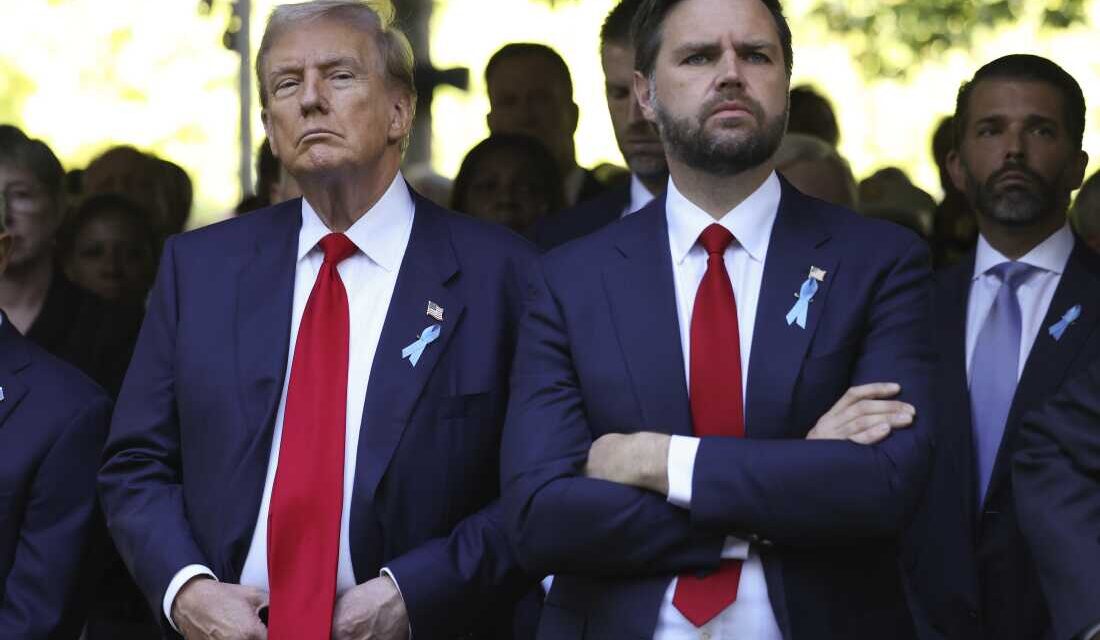
Donald Trump and J.D. Vance, New York City, September 11, 2024 (Yuki Iwamura/AP)
Originally written for The Conversation:
EA on International Outlets: Alliance No More — Trump Threatens Greenland, NATO, and Europe
One year into Donald Trump’s second term, it is clear that US foreign policy has taken a radical turn from its predecessors over the previous 80 years.
After World War II, a system of treaties and alliances saw the US commit to upholding international institutions, rules and laws, as well as to promoting global prosperity through free trade and market access.
But all these things are all antithetical to Trump’s foreign policy vision. He is pursuing the abandonment of this long-standing foreign policy stance and the abdication of America’s leadership role of the international system. Indeed, he seems intent on destroying many of the tenets and institutions of this system and replacing it with an altogether different vision of international relations.
With a background in real estate, Trump sees the world through a transactional lens. He sees alliances as a financial burden and a source of security vulnerability, and considers an open trading system to be unfair to the US as the world’s largest market. He also finds dealing with democracies more burdensome than bargaining with autocratic rulers. For him, the global system of liberal rules and institutions simply acts to prevent the US from using its power to its full advantage.
Trump has always thought this way. Before entering politics, he was a vocal opponent of the 1992 North American Free Trade Area, the World Trade Organization, the Trans-Pacific Partnership and US military intervention in Iraq and Afghanistan. What has changed is his ability to act. In Trump’s first term, establishment advisers largely put a crimp on his more aggressive instincts. Now he feels unconstrained.
Trump’s Worldview
In contrast to the post-war project, Trump’s world vision is a zero-sum game that sees trade, wealth, and security as commodities to be hoarded and not shared. He has imposed sweeping trade tariffs and threatened to abandon Washington’s NATO allies unless they pay more for their own defense.
This is a fundamental challenge for leaders elsewhere in the west. Central to the notion of the bloc is that it constitutes a common identity of shared material interest, liberal values, and – to a greater or lesser extent – shared cultural and ancestral heritage.
This shared western sense of self was central to the credibility of nuclear deterrence at the heart of its cold war strategy and the reason for Nato’s establishment. Because the nations that made up the west considered themselves to be as one, the notion that an attack on one was an attack on all was seen as credible.
Trump’s portrayal of western allies as free-riding trade rivals who exploit access to the US market while not paying for their own defense shatters this carefully constructed sense of collective identity and the credibility of the security commitment on which it rests.
This is not the only gripe Trump has with Europe. For Trump and his adviseos, Europe looks increasingly different to what they see as being the defining characteristics of the US. The America they imagine is in contrast to the liberal republicanism of the nation’s Founding Fathers and instead draws on the alternative Christian nationalist tradition in American political thought.
In this view, American identity is one that is white and Christian. This partly explains the anti-immigration policies of the Trump Administration and, in particular, why its 2025 National Security Strategy lists the end of “mass migration” as a major policy priority. It is also why Trump and his senior aides are so critical of traditional US allies in Europe.
The National Security Strategy makes much of the threat of “civilizational erasure” in Europe, arguing that “it is more than plausible that within a few decades at the latest, certain Nato members will become majority non-European”. In other words, Europe will have become majority non-white and non-Christian.
This stance was reflected by Vice President J.D. Vance last February when he told the Munich Security Conference that he was more worried about “threats from within Europe” than those posed by Russia or China. For Vance and his allies, support for right-wing parties that oppose immigration and want to limit the power and influence of the EU is central to the Adminstration’s foreign policy.
Trump’s foreign policy poses considerable challenges for those who want to protect a world order that was built by a very different US decades ago. This conflict of ideas appears to have come to a head at the recent World Economic Forum in Davos, where the leaders of many countries committed to that world order and signalled their willingness to defend their case.
Doing so, they have demonstrated that in dealing with a transactional Trump, sometimes their best response is to show him that there are certain red lines that cannot be crossed.