
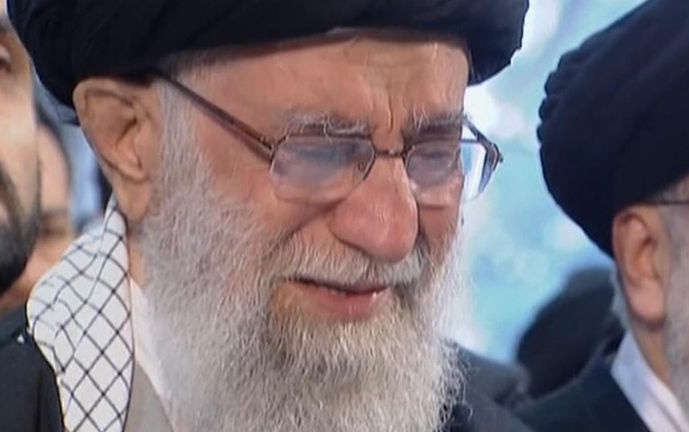
Iran’s Supreme Leader, Ayatollah Ali Khamenei (File)
Originally co-written with William Christou for The Observer:
EA on Monocle Radio and DW News: Assessing Iran’s Strikes and Protests
UPDATES: Strikes and Protests Spread Over Iran’s Economic Problems
Mehnaz was too young to protest when Mahsa Amini died in police custody three years ago after she was arrested for allegedly wearing the hijab improperly. Her mother did not let her join the throngs of crowds chanting “Woman, Life, Freedom” in Tehran and across the country – so she could only watch at home as they were beaten back by batons and bullets.
Since then, the 19-year-old computer science student in Tehran has waited for the chance to join fellow Iranians in protest. On Sunday, the moment finally came.
A sudden nosedive in the value of Iran’s currency was the final blow to a population growing tired of being patient under an ailing economy. Protests soon began in Tehran and spread, kicking off the country’s biggest protests in years – some of which have turned deadly. At least 10 people had been killed by violence surrounding the protests, with two new deaths occurring overnight.
“Despite my mother’s fears, I joined in [on protests] on Wednesday. They execute, and arrest us anyway. So people now think, if they continue to kill us when we are not even on the streets in protest, why the fuck are we waiting for the right moment?” said Mehnaz, speaking under a pseudonym for fear of repercussions.
The demonstrations started with merchants closing their shops in protest against deteriorating economic conditions and have spread from Tehran to about 32 cities across the country. What began as a movement to express economic grievances has widened in scope, with protesters chanting against the Iranian government.
Students and activists have begun chanting “Death to the Dictator”, referring to the 86-year-old Supreme Leader, Ali Khamenei, and “Woman, Life, Freedom”, echoing the 2022 protests that paralysed Iran.
As the protests have grown, so has the government’s concern. Iran’s President, the reformist Masoud Pezeshkian, initially announced he had instructed authorities to listen to the “legitimate demands” of protesters and said he was seeking dialogue with protest leaders.
At the same time, Iranian human rights groups allege security forces have used deadly force against protesters. The New York-based Center for Human Rights in Iran said on Friday that eight protesters have been killed by state security forces and dozens more injured. At least 119 people have been arrested for their involvement in protests, according to the Human Rights Activists News Agency.
Reza, a 20-year-old university student involved in the protests, described how plainclothes officers and the Basij [the volunteer paramilitary force] burst into his dorms on New Year’s Eve. They began interrogating students and beating them as they asked about who was leading the protests. Since then, many classes have been moved online to prevent gatherings on campuses where security forces have beefed up their presence.
“Joining these protests is a matter of ruining our future, but we have realised there is no future for us under this regime, so why cower and hide now?” said Reza, who asked to use a pseudonym.

“Iran government pledges dialogue with protesters
Iran’s government spokeswoman Fatemeh Mohajerani calls protesters “our children,” asserting that the administration is listening to their voices.
“All ministries and state bodies have been instructed … to engage in dialogue and pursue the people’s demands,” she posted on X.”
Excellent!!
Start by telling your thugs not to kill your “children”
In Jan 5th blog…
If “..and. one member of the security forces…” is meant for Hesam Khodayari, that is a lie by the regime.
Republic Is Lying—Amir-Hesam Khodayari Was a Protester, Not a Basiji
https://iranwire.com/en/features/147313-exclusive-the-islamic-republic-is-lyingamir-hesam-khodayari-was-a-protester-not-a-basiji/
Shooting at protesters with shotgun in Hamedan
https://www.instagram.com/reel/DS23jyADP_y/?igsh=YXBuaTc4OWxpNTR6
Regime attacking hospital to snatch the injured in Ilam
https://www.instagram.com/reel/DTGejeZDpLd/?igsh=MXNudGFwOWlmaDJ0OA==
https://www.instagram.com/reel/DTGga0XiglB/?igsh=amZtcmY5YWt4OHc1
At funeral of those murdered in Malekshahi in Ilam province
https://www.instagram.com/reel/DTFyl49jVnz/?igsh=dTZ1OWV3eTM4NDF6
An uncommon number of flights have been observed over sky of tehran, karaj, and gilan province according to videos by iranInt
https://www.iranintl.com/en/liveblog/202512283787#202601047528
[Editor’s Note: The second link is an unsupported opinion piece in line with the Iran regime’s claims.]
Three killed, several injured in unrest in Iran’s Ilam province: https://en.mehrnews.com/news/240446/Three-killed-several-injured-in-unrest-in-Iran-s-Ilam
How Israel is Manufacturing Civil Unrest in Iran as a Path to War – Analysis: https://www.palestinechronicle.com/how-israel-is-manufacturing-civil-unrest-in-iran-as-a-path-to-war-analysis/
“What began as a series of genuine protests, stemming from Iranian economic grievances, has now transformed into a fully fledged Israeli intelligence operation that seeks to destabilize Iran. It is therefore no coincidence that on the day of the Israeli PM’s departure from the United States, President Trump issued a threat to intervene militarily. In order to analyze what is currently going on inside Iran, it is important not to beat around the bush; there is an ongoing regime change effort inside the country that Israel is chiefly responsible for. Demonstrating this is not difficult either.”
[Editor’s Note: The “foreign conspiracy” line from an Iranian State outlet….]
Mossad’s objectives in fueling economic protests: https://www.tehrantimes.com/news/522408/Mossad-s-objectives-in-fueling-economic-protests
“The new strategy focuses on generating insecurity and widespread turmoil inside Iran, pushing the country into domestic conflict and then, in a weakened state, executing external aggression. More precisely, the model has shifted from “first military attack, then civil war” to “first civil war, then military attack.” This strategic change, adopted based on the experience of the 12‑day war, now turns every domestic protest—even a brief labor demonstration over currency fluctuations—into an opportunity to inject instability. Experts believe that since the war six months ago, Israel has concentrated on the role of internal factors in weakening Iran. A simple economic protest, magnified by media coverage and foreign support, can be transformed into a wave of insecurity. This approach not only reduces the risks of direct military confrontation but also enables external actors to put pressure without incurring high military costs.”