
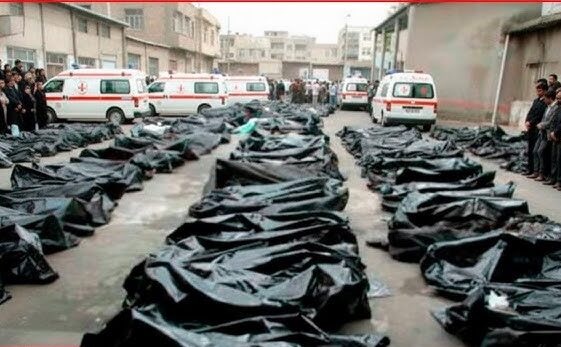
Rows of bodies in Tehran, Iran amid regime’s mass killing during nationwide protests, January 2026
Co-written with Tess McClure and originally published by The Guardian:
Supreme Leader’s Deadly Order: Crush The Protests Across Iran
On Thursday 8 January, in a midsize Iranian town, Dr Ahmadi’s phone began to buzz. His colleagues in local emergency wards were getting worried.
All week, people had taken to the streets and had been met by police with batons and pellet guns. With treatment, their injuries should not have been too serious. But emergency room staff believed many wounded young people were avoiding hospitals, terrified that registering as trauma patients would lead to their identification and arrest.
Quietly, Ahmadi — who remains anonymous due to fear of reprisals, but whose identity, credentials and presence within Iran during the unrest have been verified by the Guardian — and his wife began treating patients at a location outside Iran’s government hospital system. Alerted by a local whisper network, wounded young people flocked to them. Mostly, they brought superficial injuries – laceration wounds needing stitches and antibiotics. As Thursday evening wore on, more and more arrived to be patched up.
The next day, everything abruptly changed. Protesters kept coming, but their injuries were close-range gunshots and severe stab wounds, typically to the chest, eyes and genitals. Many proved fatal.
Ahmadi was shocked by the number being killed – more than 40 in his small town alone – but with the internet blacked out, no one knew what the national picture was. To piece it together, Ahmadi assembled a network of more than 80 medical professionals across 12 of Iran’s 31 provinces to share observations and data, and to build a clearer picture of the violence.
Their observations, shared with the Guardian and combined with accounts from morgues and graveyards across the country, begin to reveal the vast scale of violence inflicted on Iranians during the state’s crackdown. Ahmadi and his colleagues are hesitant to provide a figure for the toll but agree “all publicly cited death tolls represent a severe underestimation”. Comparing the number of dead they witnessed with hospital baselines, they estimate it could exceed 30,000, far surpassing official figures. This is based on the conclusion that “officially registered deaths related to the crackdown likely represent less than 10% of the real number of fatalities”.
Estimates of the number killed vary substantially, hampered by the ongoing internet shutdown. The Iranian government has acknowledged more than 3,000 dead, and the US-based organisation Human Rights Activists News Agency, whose figures have been reliable during previous crackdowns, says it has verified more than 6,000 dead and has more than 17,000 more recorded deaths under investigation, giving a possible total of about 22,000. Other estimates from doctors based outside Iran range up to 33,000 or more.
Testimony from morgues, graveyards and hospitals around the country reveal concerted efforts by authorities to conceal the true size of the toll: bodies being transported in ice-cream vans and meat trucks; piles of the dead being hastily buried; and hundreds of bodies apparently disappearing from Iran’s network of forensic facilities.
The language Ahmadi uses is measured and clinical, but he is brought to tears describing the violence the doctors documented. “From a medical standpoint, the injuries we observed demonstrate a brutality without limit – both in scale and in method,” he says. Another doctor, who is based in Tehran, tells the Guardian: “I am on the verge of a psychological collapse. They’ve mass murdered people. No one can imagine … I saw just blood, blood and blood.”
The Piles of Bodies
Across Iran in morgues and cemeteries, the bodies piled up – overwhelming many hospitals and forensic units, which were forced to turn trucks filled with corpses away. Graveyard and forensic medical staff describe chaos, with reports of authorities pushing for fast, mass burials to conceal the number dead.
At one morgue, staff say they were confronted with several trucks loaded with bodies, far exceeding the facility’s refrigeration and storage capacity. When staff protested that they could not process the volume of corpses, two trucks loaded with the dead were moved elsewhere – but when the morgue workers tried to track down where the bodies had been taken, they found none of the large forensic facilities in the region had received them. The doctors “expressed suspicion that this was linked to dafn-e dast-e jam’i [mass burial]”.
In a written account shared with the Guardian, Reza, a witness who says he was present at Behesht-e Sakineh, says: “On January 10 and 11, they brought in hundreds of bodies which were said to be unclaimed and unidentified.” Many of the dead, he says, were transported in small pickup trucks typically used for fruit and vegetables, and not all were sealed in body bags.
“These vehicles make dozens of trips back and forth from storage facilities … I have seen bodies in these trucks so stuck together it required strength to pull them apart. The blood was still fresh and dried up when they overcrowded them in piles.”

Jan 2026 Iran protests. Estimates of fatalities by the Islamic fascist regime:
* “More than 36,500 Iranians were killed by security forces during the January 8-9 crackdown” (Iran International, 1.25.26 [archive.is/OLySC])
* “Pahlavi insists the reports he is receiving suggest as many as 50,000 have been killed.” (Sunday Times, 1.23.26 [archive.is/H9ua0])
* ‘Ayatollah Killed 50,000 Of His Own Citizens’ (Rear Admiral Mike Hewitt. TalkTV, 3.2.26 [archive.is/OaJIR])
* “Doctor accounts from Iran peg the number to be around 50,000.” (WION, 3.20.26 [archive.is/IQIkR])
* “Dr. conservatively estimates 60,000 killed, 360,000 injured and at least 1 million directly affected.” (Journalist Shirin Sadeghi @ShirinSadeghi 1.22.26 [archive.is/6V0gp])
* “the mass killings that claimed the lives of over 60,000 Iranians.” (Agenzia Nova, 2.21.26 [archive.is/OZX4u])
* “In just three days, we lost 60,000 beautiful young lives.” (Belgian politician Darya Safai, speech on 1.25.26, posted on FB, 1.27.26).
* “UN receives reports of 80,000 deaths in Iran.” (Revista Oeste, 1.22.26 [archive.is/nlb7N]).
“Some people estimate it to 80,000.” (Natasha Devon. LBC. 1.25.26 [archive.is/m29qi])
* “Tens of thousands of Iranians have been brutally murdered—reportedly, over 80,000.”
(Aust. Sen. Raff Ciccone 2.3.26 [archive.is/z3wFt])
* “Up to 80,000 men women and children were murdered in cold blood.” (The Australian, 3.16.26 [archive.ph/Il1wK])
Statement by the Editorial Board of Iran International on death toll: https://www.iranintl.com/en/202602021839
“Since issuing a public call for the submission of documentation on those killed in the National Revolution, Iran International has received information confirming the deaths of 6,634 individuals……So far, the verified details of 1,141 individuals have been published on the “Truth Registration Map” on Iran International’s website, and this process continues daily……Of these, fewer than 100 names overlap with the 2,986-name list published by the Pezeshkian government.”
I checked a small sample of the mapped list of names (https://javidnaman.iranintl.com/) and every name listed is also present in the list provided by the Iranian government (https://files.dolat.ir/Plist.pdf), refuting the editorial that their list of names is unique. Anyone is free to compare and contrast. A photo, age and location is provided in the Iran International list but not a national ID number. In some cases, I did notice that there are variations in the surname (in Iran it is common to include the place of birth alongside the family name) which may explain some discrepancies between the two records.
[Editor’s Note: There is no evidence for the claim made by the Iranian Student News Agency about the death toll during the recent protests. The comment has been deleted.]
[From the analysis of narratives of the regime and externally-based opposition: “In different ways, both narratives ultimately sideline the protesters themselves. They reduce a diverse, grassroots movement into an instrument of power struggle, either to legitimise repression at home or justify intervention from abroad.”]
One uprising, two stories: how each side is trying to frame the uprising in Iran: https://theconversation.com/one-uprising-two-stories-how-each-side-is-trying-to-frame-the-uprising-in-iran-273573
“The Iranian regime has consistently framed the current uprising as a foreign-engineered plot, orchestrated by Israel, the United States and allied intelligence services. In this narrative, the protests are not an expression of domestic grievance but a continuation of Israel’s recent confrontation with Iran. This, it argues, is part of a broader campaign to overthrow the regime and turn the country into chaos…………………One central technique has been the legitimisation and encouragement of violence. Calls for armed protest and direct confrontation with security forces mark a clear shift away from demand-based, civilian mobilisation toward a violent uprising. A high number of state forces casualties is an example of the effectiveness of this technique. This escalation is often justified as necessary to “keep the movement alive” and generate a level of bloodshed that would compel international intervention. According to external conflict-monitoring assessments, clashes between armed protesters and state forces have in fact resulted in significant casualties on both sides.”
[Editor’s Note: The line from an Iran State outlet….]
Killing with sanctions, lying with statistics: https://www.tehrantimes.com/news/523434/Killing-with-sanctions-lying-with-statistics
“A senior official from President Masoud Pezeshkian’s office noted that the decision to release the detailed data was made with the specific goal of “closing the door to fabrication.” Just before the publication, Iran’s foreign minister told CNN Türk that the death toll was consistent with the roughly 3,100 fatalities already announced by the nation’s forensic medicine organization. He challenged critics, stating that Iran is ready to revise that number if any credible party can produce even a single verified identity not currently on the list…………alleged death tolls ranging anywhere from 6,000 to 80,000, with zero corroborating evidence. Analysts suggest this inflation was deliberate—a tactic to manufacture moral urgency and legitimize foreign military intervention, all while shifting attention away from the far better-documented civilian death toll in Gaza.”
reza, you are nothing more than dirt under the toe nail, given that anything goes with you.
‘
https://en.wikipedia.org/wiki/2026_Iran_massacres
“…A 21 January report provided to the National Security and Foreign Policy Committee of the Iranian Parliament gave a count of 27,500. Reports by the Intelligence Organization of the Islamic Revolutionary Guard Corps were of 33,000 on 22 January and 36,500 on 24 January.[52]…”
President Pezesjkian’s statement announcing the names of those killed: https://president.ir/fa/163429
“I am saddened to inform the honorable nation of Iran that the total number of victims of the recent events, as previously announced, is 3,117. Based on the policy of transparency, accountability and accountability and on the order of the President by compiling the names prepared by the country’s forensic medicine and adapted to the system of the Civil Registration Organization, the list of details of 2986 people will be published as an appendix. The reason for the disagreement between 131 people and the previously announced statistics was related to the anonymity of a number of people and the discrepancy in the registration of the national ID of a number of victims with the Civil Registration System, which will be presented in the supplementary list as soon as it is amended. The attached list includes the name, surname, father’s name, and the last six digits of the national code of the deceased. Understanding the concerns and concerns of our dear compatriots, a system has been designed whose address will be announced to the public in the next 48 hours so that any new information and claims can be investigated and verified without administrative complexity and with respect to dignity and privacy, and all possible ambiguities can be answered correctly and accurately.”
[Editor’s Note: This is an interview with Ali Bahreini, Iran’s Ambassador to the UN in Geneva. It is *not* a factual account.]
Foreign agents instructed rioters to kill and create disorder: https://genevasolutions.news/human-rights/iran-s-ambassador-ali-bahreini-foreign-agents-instructed-rioters-to-kill-and-create-disorder
“We have a great deal of evidence, and we have many videos and audio recordings indicating that the rioters received instructions and instructed one another to kill ordinary people, to kill unarmed individuals. Their purpose was to create a certain kind of violence and then attribute it to the police forces in order to level accusations that the police had killed people. The majority of civilians were killed by the rioters, and we have sufficient evidence of this. Their methods were very similar to those of the Islamic State Iraq and Al-Shams (ISIS). Police officers were instructed not to target ordinary people. They were instructed to act only when there was very dangerous behaviour, when someone was trying to kill someone else or to destroy an important site.”
Iran’s president orders names of unrest killed released: https://english.news.cn/20260129/fe6f2dbd759e4f94b608b43d71a1715a/c.html
“A system is being set up to verify information about the victims in a “clear response” to false reports and fabricated statistics, Seyyed Mehdi Tabatabaei, deputy for communications at the president’s office, wrote on social media platform X. The Iranian government has reported 3,117 deaths during the unrest.”
Khamenei call unrest an attempted coup: https://news-tunisia.tunisienumerique.com/iran-ali-khamenei-warns-the-united-states-against-a-regional-war/
“The latest sedition resembled a coup. Of course, the coup was foiled. Their goal was to destroy sensitive and influential centres in running the country. That is why they attacked the police, government headquarters, Revolutionary Guard centres, banks and mosques, and they burned copies of the Quran. They attacked the centres that manage the country’s affairs—and that resembles a coup.”
‘Bury me wrapped in the lion and sun flag’
https://www.iranintl.com/en/202601266691
This is what islamic republic brought you after 47 years
https://www.instagram.com/reels/DUGIRn6DAGQ/
Hello Deepa,
Having traveled through Iran twice, I know how big the country is and how many millions of people live in towns and cities – large and small. But when estimates of up to 20,000 protestors killed started making the rounds two weeks ago, I was skeptical since it was mostly US-based organizations or the newly co-opted CBS network pushing these figures. Now that more and more reports – like this excellent one of yours – have been able to draw on testimonies from doctors, surgeons, hospitals, morgues, and graveyards, I’m pretty shocked at the extent of the massacre. But not surprised that this was the regime’s response.
The detailed account starting with Dr. Ahmadi’s phone buzzing offers a chilling, ground-level perspective on the regime’s actions. It’s harrowing to read about the speed at which the crisis escalated in local emergency wards. I wonder about the long-term psychological toll this level of violence takes on medical staff witnessing such events firsthand.