
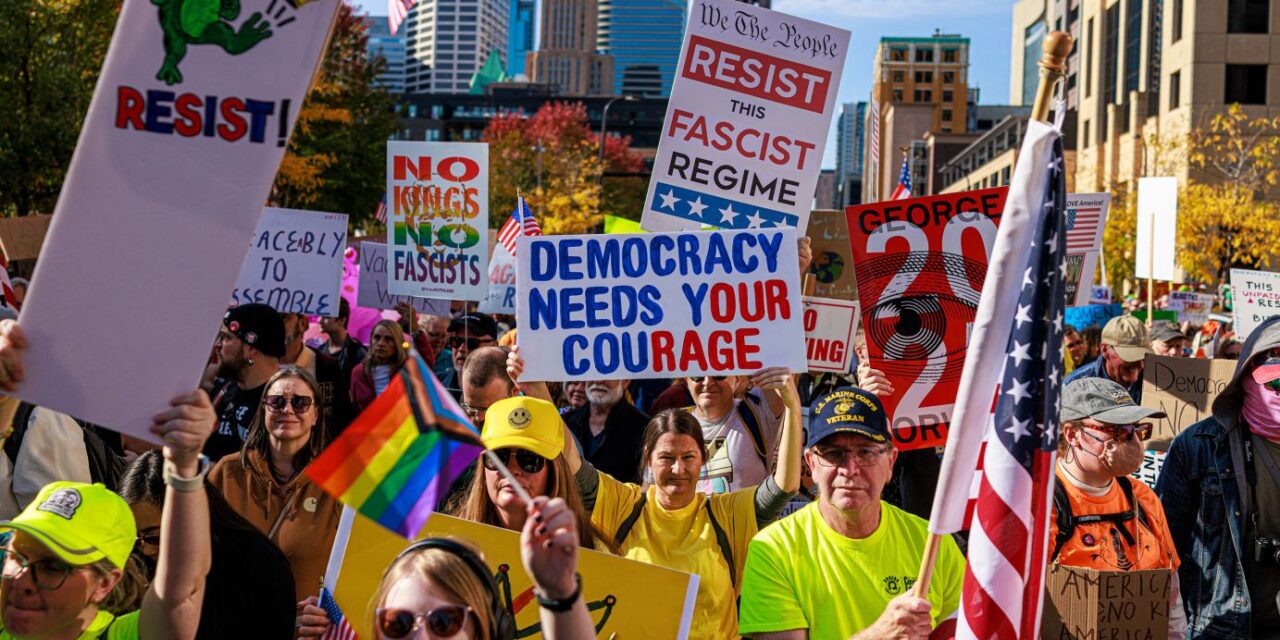
The “No Kings” rally in Minneapolis, Minnesota, October 18, 2025 (Kerem Yucel/AFP/Getty)
Britain’s Muslims Are Ready to Rebuild the UK — But is the UK Ready to Let Them?
Ideas once treated as extreme have moved into the center of political life. Language that would have ended careers is now routine. Policies that belong on the margins increasingly shape national and international debate. The unthinkable, previously whispered, is now stated openly by ministers, candidates, and mainstream commentators.
This shift cannot be ignored. Across countries and political systems, the patterns repeat. Migration is framed as invasion, diversity as decline, and equality as threat. The boundaries of what can be said have not simply shifted — they have been pushed, tested, and redrawn in full view.
Some still ask why these extreme ideas exist, and why people are drawn to them. This misses the deeper issue. The more urgent question is how the ideas gained so much ground so quickly, while so many failed to stop them. Answering that requires honesty.
We have approached this moment as a series of separate problems rather than a connected shift in how power works. Each incident is handled on its own terms, met with a response or a clarification, then replaced by the next. The effect is constant motion, but with no direction.
At the center of this approach is a belief that feels right: truth, facts and morality win in the end. It is a belief rooted in good faith, and for a long time it was reinforced by institutions and norms that helped translate those values into outcomes. But the conditions that once allowed that belief to operate automatically no longer exist.
The Wrong Starting Point
We live in an age where facts do not circulate freely. They move through systems designed to reward outrage, emotion, and engagement. In those systems, careful explanation struggles to compete with simple claims that can repeatly appeal to emotion. Acting as if these systems are neutral has left many people reacting to outcomes they do not fully understand.
We are still behaving as if power is exercised mainly through the UK Government, Parliament formal institutions, and official debate. We assume that if we hold the line there, influence will follow. In reality, much of the ground is shaped elsewhere, long before institutions engage.
Those pushing far-right ethno-nationalist ideas approach politics from a very different starting point. They often understand it less as a shared democratic process and more as a permanent struggle over survival, identity, and control. In short, they see it as war. For them, losing ground is not a policy setback but an existential threat.
This does not mean these movements are unified, disciplined, or strategically brilliant. However, they share a common worldview about what is at stake. Demographic change, migration, pluralism, and equality are framed not as social realities to be governed, but as dangers to be resisted. The language of invasion, replacement, and civilizational clash reflects this understanding.
From this follows the logic. Mobilization matters more than persuasion, and visibility more than approval. The aim is not to convince everyone, but to shape the environment in which decisions are made. The movement do not wait for Parliament, the courts, or traditional media to set the terms. They focus on the information space, where attention is won, narratives are repeated, and ideas are normalized over time. Outrage travels further than reason, and emotion often does the work facts once did.
This is how ideas once dismissed as fringe became part of everyday political language — not because they suddenly became more convincing, but because they were pushed where influence now lies.
Where Power Now Forms
For much of the past century, influence flowed mainly through institutions. Decisions made in formal settings shaped what the public heard and accepted. That is no longer the case.
Today, influence forms elsewhere, in the information space most people encounter before any formal political process begins. News, opinion, and political identity are absorbed through screens, clips, posts, and fragments designed to provoke reaction rather than reflection.
This shift is structural. Platforms reward what holds attention, and attention is more easily captured by anger and fear than by factual and reasoned argument. Claims repeated often enough begin to feel true because they have become familiar. Over time, repetition normalizes what once felt unacceptable. Once ideas are normalized in this way, institutions tend to follow rather than lead. By the time formal power moves, much of the ground has already been prepared elsewhere.
Faced with this shift, our default response has been reactive. We issue statements. We argue over wording. We rush to correct, clarify, and rebut. Each response feels necessary in isolation, but together they keep us locked into a cycle that benefits those setting the agenda.
This way of responding treats every moment as self-contained. It assumes that if the record is corrected often enough, the wider picture will take care of itself. In practice, it does the opposite. Constant reaction fragments attention, amplifies hostile narratives, and keeps us operating on ground chosen by others.
Much of this comes from good instinct. People want to be accurate, fair, and responsible. But good instinct is not the same as effective strategy. The result is that we appear busy while remaining predictable.
Our opponents do not need to win every argument. They only need to keep others reacting, divided, and focused on the surface rather than the system producing the noise.
Why Strategy Is Not the Problem
What is missing is not effort or conviction but grand strategy.
Some will say we do not need more talk of strategy, that people are tired, that this is abstract or detached from reality. They are wrong. Fatigue is not an argument. It is a symptom of years of reacting without direction, of fighting isolated battles without a sense of how they connect.
Grand strategy is not about endless discussion or perfect theory. It is about seeing beyond the immediate crisis, understanding how the different systems shaping people’s lives intersect, and making deliberate choices about where effort is focused and where it is withheld. Crucially, it also requires clarity about what we are trying to protect.
That question matters because the world is becoming more dangerous, not less. Europe now finds itself between an aggressive Russia willing to use force and disruption, and a US that is increasingly inward-looking and uncertain as an ally. In that environment, national resilience becomes critical.
Resilience is not built by hardware alone. It depends on cohesive societies and communities that trust their institutions and one another under pressure. Equal protection under the law, human dignity, and equal citizenship are not abstract ideals. They are the foundations that allow diverse societies to hold together when they are tested. Without them, democracies become brittle, divided, and easier to destabilise from within.
The rise of far-right ethno-nationalism undermines that resilience. It treats difference as weakness and belonging as conditional, fracturing the social fabric upon which democratic societies rely in moments of stress.
Grand strategy means recognizing how economic insecurity feeds grievance, how grievance is targeted by disinformation, and how narratives travel across social, cultural, and political lines. It means understanding that the information space does not sit apart from material conditions, but feeds on them and reshapes them.
A strategic approach means choosing when not to respond, deciding which stories deserve attention and which lose power when ignored, and making sure efforts in one area do not cancel out progress in another. It focuses less on chasing every provocation and more on shaping the conditions that allow harmful ideas to take root in the first place.
Choosing Direction Over Drift
Choosing direction is not about finding the right message or reacting with greater urgency. It is about deciding which principles guide action and where lines do not move.
In a more dangerous world, resilience depends on that clarity. Principles such as equal protection under the law, dignity, and equal citizenship are not optional. They are the rules that allow plural societies to function under strain, and the standard against which decisions should be tested.
Refusing to think in these terms does not protect our values. If we keep treating each moment as a one-off, mistaking reaction for progress and avoiding the harder work, the direction is obvious. The world our children and grandchildren inherit will be less open, less tolerant, and less safe than the one we were given. That future will not arrive in a single shock. It will be built slowly, through patterns allowed to continue and choices left unmade.
The task now is not to react faster, but to think and act with purpose. To connect the systems shaping people’s lives, to organize for the reality we are in, and to stick to a direction over time.
Anything less is not caution or balance. It is a choice to let others decide the future and have us live with the consequences.

Trackbacks/Pingbacks