
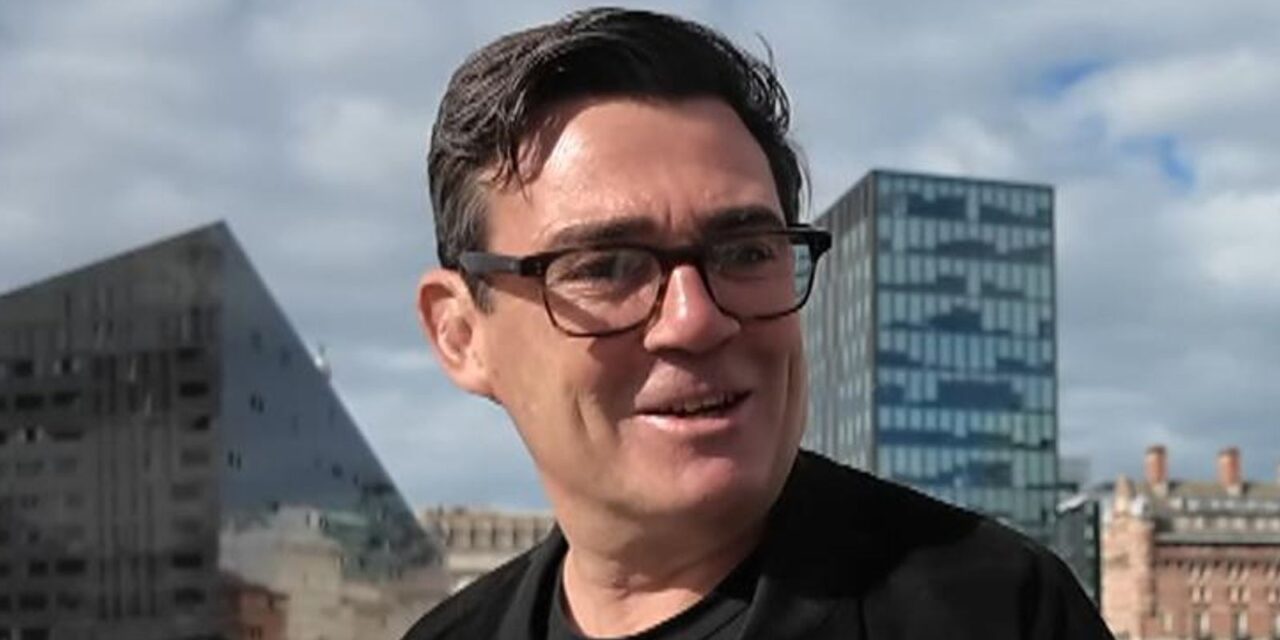
Andy Burnham, the Mayor of Manchester in northwest England (Sky)
In Search of Conviction: Why the UK Can’t Produce A Mamdani (Yet)
There’s a reason the phrase “King of the North” resurfaces whenever the name of Andy Burnham, the Mayor of Greater Manchester in northwest England, is mentioned.
It’s a label that unsettles the center of the UK Labour Party and the Government of Prime Minister Keir Starmer. Burnham’s political authority has been built outside Westminster, not manufactured within the bubble. His legitimacy comes from governing Greater Manchester as a maverick and radical mayor, rather than aligning himself with the churning of the party machine in London.
That is why Labour’s National Executive Committee did not just discourage Burnham for standing for Parliament in the Gorton & Denton by-election. They blocked him in an 8-1 vote, shutting the door before local members had a say.
That is where this becomes more than just another factional skirmish. It goes to the heart of how Labour now operates — and why it still struggles to understand its vulnerability. In 2020, Keir Starmer tweeted, “Local parties should choose their candidates.” That principle has been dismantled if it does not align with the agenda of those in power, or if any incumbent is threatened with political mortality.
The Problem of Management Over Conviction
The NEC’s reasions for Burnham’s disqualification do not stand up to scrutiny. He is not a politician from London, seeking relevance, parachuted into a distant constituency. He is rooted in Greater Manchester. He has won repeated mandates, and speaks with an authority grounded in delivery of pledges. His voice carries the imprint of governing a city-region with real budgets, real services, and real consequences.
Burnham has consistently argued for devolution as a remedy to Britain’s centralized paralysis, long before it became fashionable to say so. His book Head North, co-authored with Liverpool Mayor Steve Rotherham, makes a blunt argument: Britain is broken because too much power is hoarded in Westminster. That premise alone puts him at odds with a party leadership increasingly invested in control, discipline, and containment.
This feeds into a broader problem which Labour refuses to confront, as British politics prizes management over conviction, safe sentences over meaningful change. However, blocking Andy Burnham will not weaken populism and the rise of the hard right; it will fuel it.
Reform UK thrives on the argument that politics is rigged, remote and unresponsive. Barring with internal procedure a popular, regionally-rooted figure validates that narrative. This is how people conclude that politics is not about choice, it is about permission.
Some on the left, including Greens and Labour voters drifting away, see Burnham as proof that public power can work when devolved. His record on transport, social infrastructure and integrated services in Greater Manchester has been repeatedly cited as evidence that redistribution of power delivers results.
The Erosion of Democracy
But the issue here is internal. Burnham’s presence unsettles Labour’s Westminster operation from the NEC to Starmer’s inner circle because he cannot be message-managed. He does not arrive pre-approved by focus groups. He speaks plainly, sometimes awkwardly, and with conviction — a threat to a system built to minimize risk rather than mobilize belief.
So instead of engaging with what he represents, Labour has reverted to form: procedural barriers, reframing of the narrative, and quiet briefings about unity and priorities. The policy debate becomes a story about personalities, as democracy is reduced to a process selectively applied.
This is not just about Andy Burnham returning to the Commons. It is about whether Labour still believes what it once said about trust, pluralism, and local democracy, or whether those principles now only apply when the outcome is safe.
If Labour keeps asking why populism keeps winning, it should look closely at this moment. Because when parties close ranks, block choice and mistake control for strength, they don’t just lose arguments. They lose people.
As a Burnham supporter said after the NEC’s ban of the Mayor’s campaign, “They do not yet feel a burning sense of the existential threat to the party.”
